
At the Aramark Community Teaching Kitchen inside the College of Public Health, students learn to make more from what they already have.

Temple students turned cucumbers and onions into pickled vegetables during a sustainability workshop at the Aramark Community Teaching Kitchen, making their own brine and then taking their jars home.
Photo by Betsy Manning
Cucumbers and onions were piled high beside empty mason jars, spices and brine as over 30 students gathered on Wednesday for the first-ever Kitchen Sustainability Workshop Series hosted by the Office of Sustainability and the Aramark Community Teaching Kitchen in Paley Hall.
“We want to address food insecurity and waste,” said Paris Ford, the Research & Kitchen Coordinator at the Aramark Community Teaching Kitchen. “So one way that we can do that is to promote zero waste.”
The workshop provided students with a hands-on lesson about sustainability and food waste by teaching about food preparation, like pickling, which prolongs the life of produce, well beyond its harvest season and can save it from the landfill
“A lot of people may like pickles, but they don’t know that they can pickle themselves,” Ford said. “It’s a pretty simple process. So through this workshop, we’re excited to expose students to ways they can be sustainable, save money and learn how to use all their resources in their small kitchens in their residence halls.”
Students chose between cucumbers and onions, mixed their own brine and learned the basics of pickling.
Amber Beckworth, a Health Professions major and Class of 2029, is a student-worker in the Kitchen. She said the workshop showed students that eating well and becoming more self-sufficient in the kitchen can take little more than a few simple ingredients and a willingness to try.
“This class teaches you how to do things on your own so that you are able to maintain your healthy diet and live longer,” Beckworth said. “Being sustainable is something that we can make part of our everyday lives.”
Fox student Olivia Ims, Class of 2028, found the event through Temple's sustainability social media accounts.
“I came to learn to cook and prepare food for myself," she said.
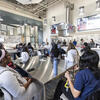
At the Aramark Community Teaching Kitchen inside the College of Public Health, students learn to make more from what they already have.
Photo by Betsy Manning
By the end, the cucumbers were crisp. The onions were sliced. Then came the brine.
“It was so fun to do this with friends and have a crunchy, healthy snack to bring home,” Ims added.
Caroline Burkholder, Temple's senior sustainability manager, said the workshop showed learning by doing, which is emblematic of the Temple experience.
“Temple University’s campuses and its spaces, like the Teaching Kitchen which composts all its food waste, are living labs in a way,” Burkholder said “Food waste is a huge challenge on campus and globally. This workshop gives students a chance to learn skills for food recovery and waste reduction and put them into action. It helps them understand the impact of making more sustainable choices in the kitchen and across campus.”
Burkholder added that the workshop was also a lesson in finding new ways to use food that might otherwise go to waste.
“By preserving cucumbers, onions and other ingredients, students learned how simple techniques can extend the life of food and reduce what ends up in the trash,” she said.
That focus reflects Temple’s broader commitment to minimizing waste and addressing food insecurity.
“The Community Teaching Kitchen is part of that effort. Its composting program, developed through a partnership with the Office of Sustainability, was the genesis for the workshop and continues to give students a hands-on way to think about what happens to food scraps after a meal or cooking project,” Burkholder said. “Together, the programs show how small, practical changes, from preserving food to composting scraps, can add up to a more sustainable campus.”
While the workshop was required for some students as part of an environmental health class, Buenja Antonio, Class of 2028, appreciated the encouragement to take part.
“I’m excited because I don’t know how to cook,” he said. “I’m looking forward to attending more workshops, like these, to learn how to because it’s fun and easy to do.”
Ford hopes students leave with both a jar of delicious pickles and the knowledge that good, healthy cooking is within reach.
“Cooking is really about learning what you can do with what you have,” she said. “You can take a few simple ingredients and turn them into something really great.”
This event was part of Campus Sustainability Month, an annual program series from the Office of Sustainability, produced each October. The one-time events are free and open to students beyond the College of Public Health. The next workshop, called Seed Saving and Low Carbon Eating, will show students ways to regrow fruits and vegetables. That is scheduled for Oct. 28. Students are also encouraged to follow Sustainability and their partners on Instagram: @tusustainability @cph_kitchen @temple_cph.
