The Startup World Cup was hosted at Temple on Friday, giving Philadelphia entrepreneurs a chance to compete on a global stage.
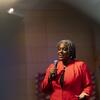
Tempest Carter, CLA ’10, opens the Philadelphia Regional Startup World Cup Pitch Competition on Sept. 18, held at Temple University.
Photo by Ryan Brandenberg
Temple, in partnership with Department of Commerce, host Philadelphia Regional Startup World Cup Pitch Competition
On a busy Friday afternoon inside Temple University’s Science Education and Research Center (SERC), Tempest Carter, CLA ’10, is on the move, shaking hands, greeting old friends and colleagues, and introducing herself to new ones.
In a few minutes, she will take the stage to welcome hundreds of entrepreneurs, scientists, students and members of Philadelphia’s technology community to Temple for the Philadelphia Regional Startup World Cup Pitch Competition.
“Temple and Philadelphia are both hubs for innovation,” Carter said.
For the third consecutive year, Temple served as the Philadelphia host of the Startup World Cup regional competition in partnership with the Department of Commerce, bringing 10 Philadelphia startups to campus to pitch their businesses on Friday, Sept. 18, to investors and entrepreneurs for a chance to reach the global stage.
“This event works directly with investors, with capital movers, with power players, helping to make a name for Philly. So I’m proud to host the event back here at my alma mater,” Carter said.
There are more than 100 regional events in the global Startup World Cup network. The competition in Philadelphia is organized by Carter, who is the strategic technology initiatives director for the City of Philadelphia’s Department of Commerce. The Philadelphia winner received $25,000 and an automatic spot at the international finals in San Francisco, where regional winners from around the world will compete for a $1 million investment.
“I knew Temple had both the talent and the resources to be able to hold something of this magnitude because of what my Temple education has done for me,” Carter said.
“Temple is committed to creating an environment where ideas can foster positive change and have real impact on people,” said Josh Gladden, Temple's vice president for research. “Events like the Startup World Cup bring together the researchers, investors and innovators who can make that happen.”
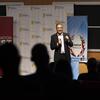
For the third year in-a-row, hundreds of people gathered at Temple on Friday for the Startup World Cup.
Photo by Ryan Brandenberg
Global learning provided by a Temple education
Carter grew up a few miles away from Main Campus in Strawberry Mansion. She studied Temple from 2006 to 2010, majoring in economics through the College of Liberal Arts and minoring in Spanish.
Carter said she began her college career at Temple wondering why people make the choices they make and what could be done to create economic opportunities.
“I think poverty is something that’s created, so I think it can be destroyed,” she said.
While she lived close to home most of her life, her Temple education eventually took her far beyond North Philadelphia. A university study abroad program brought her to Mérida, Mexico, where she immersed herself in Latino history and language. After graduating, she joined the Peace Corps and spent two years in Panama, where she worked in environmental conservation. Carter organized workshops, where she taught in a village to turn waste materials into products they could sell, including pocketbooks made from chip bags and soap made from discarded oil.
“All those things actually did help me learn to understand patterns and see how people make choices, and what the cost of innovation is,” Carter said.
She is now a leader in Philadelphia’s technology and investment community.
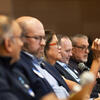
Organizers hope attendees continue to view Temple and Philadelphia as hubs of innovation.
Photo by Ryan Brandenberg
Bringing the competition to Temple
Three years ago, she approached Temple about bringing the Startup World Cup’s Philadelphia competition to campus.
The university said yes.
The event has grown each year, moving from Mitten Hall to SERC. This year saw a record attendance, with more than 300 people.
“I think it was amazing,” said Crystal Evans, an attendee and founder of Money Talks EDU. “Everybody, they knew their niche, and they pitched well.”
Her organization is developing a financial literacy curriculum they hope to pilot in Philadelphia high schools.
Anthony Harvey attended to network and learn more about innovation at Temple and throughout Philadelphia and said he was impressed by the range of companies.
“I loved it,” he said. “We’ve seen such a variety of hardware, software and AI companies.”
The 10 Philadelphia startups competing Friday represented a broad range of industries and technologies. Each founder had three minutes to pitch a business, followed by two minutes of questions from judges that included investors and accomplished entrepreneurs.
Keith McMeniman, founder of the Philly Tech Council, also attended to learn about new companies and new trends.
“The competition shows just how technology affects every business out there,” McMeniman said. “At the end of the day, it’s all powered by technology.”
McMeniman, who grew up in Fairmount, said Temple has long stood out for its combination of education and entrepreneurial energy.
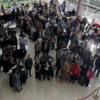
The top three Startup World Cup finishers receive free workspace through iNest, along with connections to Temple’s technology transfer office, which helps researchers commercialize their work.
Photo by Josh Gladden
Temple’s role in the competition served as more than the host. For instance, the university’s Innovation Nest, or iNest, also played a role. Located in the Kornberg School of Dentistry building on North Broad Street, iNest provides incubation space for entrepreneurs. iNest is also home to Mid-Atlantic Diamond Ventures, an angel investor program and forum that serves startups throughout the Mid-Atlantic. The top three Startup World Cup finishers receive six months of free workspace through iNest, along with connections to Temple’s technology transfer office, which helps researchers commercialize their work.
Temple is also home to the Small Business Development Center and the Innovation and Entrepreneurship Institute within the Fox School of Business.
Together, those resources connect the Startup World Cup to Temple’s broader work supporting entrepreneurship and innovation, Carter said.
“I love getting folks money,” she said. “I love making capital move and creating a platform where businesses can connect to potential clients, potential partners and potential investors.”
Previous Philadelphia competitors have gone on to raise significant capital. Carbon Reform, the inaugural first-place winner, has since raised more than $10 million for its carbon-capture technology. Lily Chen of Fish Tech later raised a $25 million round, Carter said.
Carter hopes others continue to view Temple and Philadelphia as hubs of innovation.
“The idea of Temple Made is real, the network is real,” Carter said. “I really owe so much of my life, and my career, to my time at Temple University. It’s still paying dividends for me.”’
