
Temple University’s Tamaqua Dental Clinic and Education Center is now open, providing clinical education to dental students while serving approximately 30 patients a day. The facility is bridging a gap to bring high-quality oral healthcare to a population that needs it most.
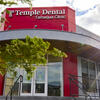
Temple University’s Tamaqua Dental Clinic and Education Center is bridging a gap to bring high-quality oral healthcare to Pennsylvania's rural communities.
Photo by Ryan S. Brandenberg
It was just over a week ago that Kaushal Upadhyay was in the middle of his new morning workday routine at Temple University’s Tamaqua Dental Clinic and Education Center, and a walk-in patient arrived.
For more than 10 months, the patient had been dealing with excruciating tooth pain, and it was clear that an extraction was necessary. The patient, however, had been unsuccessful in scheduling a dental appointment anywhere in the surrounding area, and with no access to high-quality dental care, the patient had made the decision to see a traditional primary care physician. Their solution was prescribing an antibiotic along with over-the-counter Tylenol.
Upadhyay, a third-year student in Temple’s Kornberg School of Dentistry’s dentistry (advanced standing program for internationally trained dentists) DMD, quickly conferred with the attending faculty member at the clinic, before returning to the patient with an emphatic response on how to move forward:
“We can pull your tooth today.”
Realizing they would soon be free of pain, the patient became overwhelmed with emotion and began weeping tears of joy.
The unfortunate reality is that his experience is not uncommon. According to a recent study from the CareQuest Institute for Oral Health, rural populations have the worst access to dental healthcare, as 40% of adults living in rural environments have not visited the dentist in more than one year.
It is not because they do not want to visit the dentist, either. It is because there is no option to do so. But for residents who live in the Pennsylvania counties of Schuylkill, Carbon and Luzerne, that is about to change.
Addressing rural healthcare challenges head on
This fall, Temple University’s Tamaqua Dental Clinic and Education Center opened its doors. Located at 205 Center St., Tamaqua, a rural neighborhood located in Schuylkill County approximately two hours from North Philadelphia, the clinic essentially operates as a satellite location for Kornberg. It is housed in a former Rite-Aid that was renovated and transformed into a state-of-the-art facility.
Currently, nine Temple dental students are pursuing their education there, working hand in hand with Kornberg faculty members and licensed dentists, who work at the facility. This is not a traditional clinic training. The students live in a Temple-leased property in Tamaqua, and in every way, they are embedded into the community.
The clinic and education center is the brainchild of Amid Ismail, Laura H. Carnell Professor and dean of Kornberg, who has built a career on bridging gaps to bring high-quality oral healthcare to the populations that need it most.
“For me, the role of the Kornberg School of Dentistry has always been to take care of the individuals who are the bottom of the economic pyramid,” Ismail said.
Nearly four years ago, Ismail and the Kornberg School partnered with the School District of Philadelphia to open a pediatric dental clinic at William D. Kelley Elementary School in North Philadelphia. In the time since, it has served nearly 1,000 elementary school students, providing young people with easy access to high-quality dental care.
Ismail has similar expectations for the Tamaqua clinic, which he believes can be life-changing for residents who live in the surrounding rural counties. While there are a handful of rural clinics run by universities across the country, this is a first for Pennsylvania.
“In Pennsylvania, this is the only model like this. While there are other clinics, none of them require the students to live there. They will just drive back and forth and rotate,” Ismail said. “Here, there's no rotation; it’s residential. That is the key part. They live in the community, learn about the community, are part of the community and they take care of it. That is what makes this so special.”
For years, this is the exact type of clinic that Ismail has wanted to open, as he long desired for an opportunity to bring the compassionate, comprehensive, patient-centered, evidence-based and outcome-driven oral healthcare that is a hallmark of the Kornberg School to rural communities. He just needed the right partner.
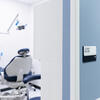
Temple's Tamaqua Dental Clinic and Education Center is a state-of-the-art facility where students work and learn in an environment similar to what is found at the Kornberg School of Dentistry.
Photo by Ryan S. Brandenberg
An answered plea
Just over two years ago, Ismail attended a meeting for the Pennsylvania Coalition for Oral Health, where he discussed the challenges that rural communities face from a severe lack of dental care, often driven by provider shortages, geographic isolation and limited insurance options.
As his talk concluded, Ismail made a plea.
“I stood up, gave my talk, and then I raised my hand and said, ‘If you want to work with me to open a dental clinic in a rural area where we can have the students embedded as part of the community, come talk to me,’” Ismail recalled.
One person approached him: Micah Gursky, the executive director of the Tamaqua Area Community Partnership.
“When Dean Ismail announced that he wanted to create a program to train dentists in a rural community, I asked him to look at Tamaqua. My hometown of Tamaqua is a gritty Appalachian coal town where medical education has helped create access to family medicine and psychiatry that didn’t otherwise exist—so why not dental care?” Gursky said.
From there, the project was put in motion. Together, Gursky and Ismail worked to connect with legislators and garner support for the project. It turns out that it was an easy sell.
State Rep. Jamie Barton (R-124) and state Sen. Dave Argall (R-29) quickly got on board and worked to secure funding to help bring the project to fruition. In total, the Pennsylvania Department of Community and Economic Development, the U.S. Department of Agriculture, the Tamaqua City Revitalization and Improvement Zone, and the Morgan Foundation all supported the development of the Tamaqua Dental Clinic and Education Center.
“Our community partners stepped up to work with Temple because we share the belief that a true rural program will be a great experience for the students and our town,” Gursky said.
One of the strongest and most public endorsements for the project came in March 2026 when Temple University President John Fry was in Harrisburg, advocating on behalf of the university and the commonwealth’s state-related institutions. One of the legislators in attendance was Barton, who approached the podium to share his thoughts on the forthcoming dental clinic.
“President Fry, my grandma used to say when God closes a door, he opens a window. In Schuylkill County, we say now that when God closes a Rite-Aid, he opens a Temple dental clinic. That’s not really true, but that’s what I say,” Barton said. “Rural health, in general, is a real concern and Temple’s investment in rural dentistry shows great vision and accountability.”
An immersive educational experience
Part of what makes the learning experience so unique at the Tamaqua Dental Clinic and Education Center is the fact that the students are completely immersed into the Tamaqua community. They live there, eat there and sleep there. That is not by accident.
Ismail’s hope is that students will enjoy the experience and ultimately choose to open a dental practice in a rural area upon graduation. It is another way he hopes the clinic helps further solve the oral healthcare issues facing rural communities.
“When we talk to students about coming here, one of the first things we ask is, ‘What is your desired lifestyle?’ For some students, this is not going to be it, but for others, this is going to be exactly what they are looking for as they begin to launch their careers and open their own practices,” Ismail said.
The experience has been especially meaningful for Paulina Adames, a third-year dental student who is originally from West Fargo, North Dakota.
“Since moving to Tamaqua and starting in the clinic here, this has been one of the most rewarding experiences for me, both in serving the community and in my clinical growth and ability to truly show up as myself,” Adames said. “The warm, family-like environment makes the experience even more special. The amount of learning and hands-on experience I gain each day is helping me grow in confidence as a clinician.”
Sami Al-Khsawneh, also a third-year dental student, has had a similarly positive experience.
“Although Tamaqua is primarily an educational institution, it also embodies a unique commitment to community service. The delivery of dental care here stands as a remarkable example of selfless dedication and giving back to the community,” said Al-Khawneh, who is originally from Jordan. “Being part of this program has been a privilege, and I have never doubted that choosing to participate was one of the most valuable and memorable decisions in my educational journey.”
For students working at the Tamaqua Dental Clinic and Education Center, the sterilization room is also an educational experience in itself.
It is complex and far beyond what is seen in a traditional dental setting, as every instrument is required to go through a multistep process that includes manual/ultrasonic cleaning, automated washer-disinfection and pouch-sealing before final sterilization.
“This is not what it is like in a dental office,” said Fabian Matthews, Kornberg’s sterile processing assistant manager who oversees the sterilization room at the Tamaqua clinic. “This is what we have in Philadelphia at Kornberg, and this is what you see in a hospital setting or at a medical school. It’s that advanced.”
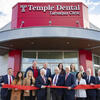
On Friday, Nov. 6, university leaders and government officials gathered for a grand opening ceremony at the Tamaqua Dental Clinic and Education Center.
Photo by Ryan S. Brandenberg
A grand opening to remember
On Friday, Nov. 6, a collection of legislators and members of the Temple and Tamaqua communities gathered at the clinic for a ribbon cutting and grand opening celebration.
“I am not much of a marketer, but ever since this project first was announced, we have coined a little saying that we share around the office. ‘Temple University: from Tokyo to Tamaqua.’ Sure, it’s fun to say, but it also demonstrates the significance of this initiative,” Fry said while addressing the more than 100 individuals in attendance.
While the clinic has only been open for a little more than two months, its impact is already profound. And it is only going to grow even further.
Today, it serves approximately 30 patients a day. In 2027, that number is expected to at least double.
By next fall, the clinic is expected to expand its student workforce by 20, welcoming 10 third-year and 10 fourth-year dental students. Additionally, renovations at the student housing facility, located at 24 W. Broad St., will be fully complete in 2027, which will further extend Temple’s footprint in the Tamaqua community.
And, next year, thanks to the support of a $600,000 gift in kind from Henry Schein Cares, this clinic will start a school-based dental program.
“This is the work that we do. It is mission centric for Temple and for the Kornberg School of Dentistry. We have done this in North Philadelphia at the William D. Kelley School, and now, we’re going to do this here in Tamaqua,” Ismail said. “When a community needs support, we are there to help lift them up.”

