The event focused on how trauma-informed principles can be applied in higher education.
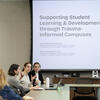
Laura Sinko and Krista Schroeder, both associate professors of nursing in the College of Public Health, presented a breakout session during the Trauma-Informed Campus Conference.
Photo by Ryan S. Brandenberg
Amid heightened national attention to trauma and its effect on individuals and communities, faculty, staff and students from universities throughout the region recently gathered at the Temple University College of Public Health (CPH) for an important dialogue.
They participated in the Trauma-Informed Campus Conference: Developing Novel Approaches for Higher Education held on Oct. 23 at Paley Hall to explore how institutions can translate trauma-informed principles into practical approaches to teaching, student support and campus policies.
The event comes as institutions around the country are facing a downturn in enrollment, financial issues and other setbacks.
“We know that right now in higher education we face some significant challenges,” Jennifer Ibrahim, dean of CPH, said during her welcoming remarks.
She acknowledged that some college students throughout the country have been impacted by accidents, fires, thefts, sexual assaults and other traumatic events.
“We want to think about the different ways that we can address trauma and think about it from a prevention, a reaction, and then a recovery and a rehabilitation perspective,” Ibrahim told conference attendees. “We really hope that you will be thinking not only of the current knowledge, but being innovative and creative in thinking about policies, systems, practices and the ways that we can modify where we are to be as successful as possible.”
The event was organized by Temple’s Trauma-Informed Campus Workgroup, which is comprised of faculty, students and staff. The group is committed to creating a trauma-informed campus by advising university leadership and reviewing Temple’s programs, policies and practices.
Tricia Shalka, associate professor at the University of Rochester, gave a keynote presentation during the conference on what pulls people towards and away from adopting trauma-informed practices.
She addressed the ways in which higher education institutions can compound trauma through both action or inaction.
“We like to imagine that trauma is something that is happening out there, that it’s something that we can support people through or be reactive to, but it’s much harder for us to look in the mirror and know that we actually create harm,” Shalka stated. “We create trauma and retraumatization by virtue of our practices and policies in higher education.”
She emphasized practices that faculty and staff can undertake as they lean towards addressing trauma, which include prioritizing relationships, emphasizing safety and keeping themselves out of the storyline.
Shalka said research has shown that empathetic relationships are one of the most successful ingredients in helping people successfully recuperate from trauma.
“My vision is always that every single student on our campuses has at least one faculty member and one staff member that they have a close connection with,” she continued. “That should be what we are aspiring to as institutions.”
Shalka acknowledged the emotional toll of engaging with another’s trauma and importance of maintaining boundaries.
“The traumatic engagement is where we are putting ourselves into somebody else’s experience. We are making it our own, but it is not ours,” she stated. “There is a way to do this work and to be empathetic and be present without putting ourselves into the storyline that then becomes traumatic for us.”
The second keynote was presented by Mandy Davis, who serves as director at Trauma Informed Oregon, a statewide collective aimed at preventing the impact of adverse experiences on children, adults and families.
Her presentation addressed how the essential elements of the trauma-informed care (TIC) framework was developed, and lessons learned along the way.
The framework features five elements which include organizational commitment, culture and climate, training and education, procedure and practice review, and feedback and quality assurance.
“It’s a compass for action,” Davis said as she reflected on the framework.
She highlighted the TIC Implementation Tool, which was created by Trauma Informed Oregon and the Human Services Implementation Lab to assist organizations and agencies in executing trauma-informed care and tracking their progress. TIC approaches in the workplace, educational or healthcare settings can help people who were exposed to prior traumatic experiences.
“To me, trauma-informed care is a people’s movement that recognizes the harm that systems have done to individuals or groups,” Davis stated, as she referred to basic needs, childcare, educational and healthcare organizations.
“They can either create new harm by the way they do things, or by denying access to things or activate old harm or retraumatize people.”
Davis commended Temple for adopting trauma-informed care practices.
“Temple is advancing this work,” she stated. “They are embedding the principles into higher ed and that is exciting because it is not happening in a lot of places.”
The conference also featured breakout sessions on topics such as protecting students in internship and clinical spaces, a trauma-informed approach to hazing, supporting student learning and development through trauma-informed campuses, and creating trauma-sensitive schools in North Philadelphia.