
Temple President John Fry sat down with renowned psychologist Kathy Hirsh-Pasek to discuss her research journey and how playful learning is transforming education in Philadelphia and beyond.
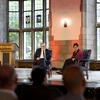
Temple President John Fry and psychology professor Kathy Hirsh-Pasek explore how playful learning is reshaping education during the university’s fall Innovation with Impact event at Mitten Hall.
Photo by Ryan S. Brandenberg
For more than three decades, Kathy Hirsh-Pasek, the Stanley and Debra Lefkowitz Faculty Fellow in Temple University's Department of Psychology and director of the Temple Infant and Child Lab, has dedicated her career to understanding how children learn. From authoring books on childhood development to transforming public spaces into opportunities for playful learning, her research has helped reshape conversations about education in Philadelphia and across the globe.
That work took center stage Monday, Oct. 12, as Hirsh-Pasek joined Temple President John Fry for the university’s fall Innovation with Impact event, held in the Great Hall of Mitten Hall. The fireside chat explored the evolution of Hirsh-Pasek’s Playful Learning Cities initiative, her efforts to bring learning science into classrooms and the challenges of translating research into practice.
Elizabeth A. Wentz, Temple’s senior vice president and provost, welcomed attendees and introduced Hirsh-Pasek before the conversation began.
“Kathy’s work is a powerful example of how research can make a meaningful difference in the communities we serve,” Wentz said in her remarks. “By bringing the science of learning into everyday spaces and working alongside community partners, she is helping create new opportunities for children and families while demonstrating the kind of innovative thinking that makes Temple a leading research university.”
One of the conversation’s central topics was Playful Learning Landscapes, an initiative that transforms public spaces such as parks, bus stops, supermarkets and playgrounds into opportunities for children to develop language, math and problem-solving skills.
Hirsh-Pasek recalled early experiments in Philadelphia that demonstrated how changes to familiar environments could encourage richer interactions between parents and children. The installations were developed in collaboration with local residents.
“The idea that children learn best through play is simple, but a really profound idea,” Fry said during the event. “What makes Kathy’s work so remarkable is how she has taken that understanding and challenged us to rethink where and how learning happens.”
Those efforts helped establish Philadelphia as the world's first Playful Learning City, a milestone celebrated during the inaugural International Day of Play. The model has since expanded to 33 cities across 13 countries, Hirsh-Pasek shared.
Hirsh-Pasek's participation in Innovation With Impact comes during a month of notable recognition for her research. Earlier in October, she received the University of Pittsburgh's Distinguished Professional Achievement Award, which honors alumni who have demonstrated sustained excellence and leadership in their fields. During the award presentation, the dean highlighted Hirsh-Pasek's contribution as a translational scientist, particularly her work bringing research into communities through initiatives like Playful Learning Landscapes.
Hirsh-Pasek is also exploring how playful learning can be integrated into traditional classrooms. With support from the LEGO Foundation, she and a national team of researchers are conducting a five-year study of Active Playful Learning in kindergarten through fourth-grade classrooms across California, Illinois, Texas and Virginia.
Now three years into the project, researchers are seeing encouraging early signs of improved student engagement, academic development and opportunities for children to exercise greater voice and choice in their education.
Fry also asked Hirsh-Pasek how decades of research on childhood learning have shaped her own approach to teaching at Temple.
“What I’ve learned through my research is that students learn best when they’re actively engaged in the process,” Hirsh-Pasek said. “That’s just as true for college students as it is for young children. I want my students to do more than listen to a lecture. I want them to ask questions, work together and apply what they’re learning to solve real-world problems.”
As the conversation concluded, Hirsh-Pasek challenged fellow researchers to think boldly about their work and the importance of making scientific discoveries accessible beyond academia.
“It’s about the impact as much as it’s about publication,” said Hirsh-Pasek. “Can we, at the same time, look at what we know and say, ‘How can it be helpful to the people who are around us?’”
