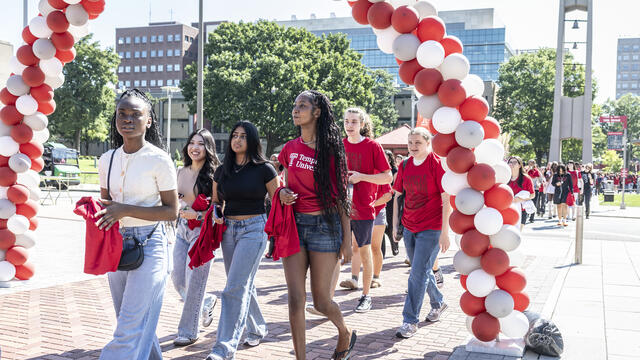
The Temple community and state and city leaders gathered at the Hub, located in the lower level of the Howard Gittis Student Center, for a ceremonial ribbon cutting on Oct. 8. This centralized space offers new and expanded resources for food, housing, transportation, clothing, health and well-being, and more.
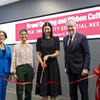
Temple celebrated the grand opening of its 30,000-square-foot Essential Needs Hub, bringing together university leaders, community partners and state and city representatives.
Photo by Ryan S. Brandenberg
On the back of her phone, Alexis Gonsalves proudly displays a sticker that reads “The happiest people don’t have the best of everything. They make the best of everything.”
She got the sticker during her first visit last spring to the Essential Needs Hub, where she sought printing help.
“To me, this sticker was the first sign of just how important the Hub was going to be,” said Gonsalves, a Class of 2027 biology major. “I was pleasantly surprised to find a place where everyone genuinely wanted to help me. I left with more than just a sticker. I had a desire to help build the amazing community I already saw taking shape.”
At the time, the Hub was just starting to launch. Now, it is fully operational and recently celebrated a ceremonial ribbon cutting, inviting the Temple community and state and city leaders to experience the 30,000-square-foot space located in the lower level of the Howard Gittis Student Center.
Since opening to students on Aug. 21, the Hub has had more than 22,000 visits, demonstrating both the demand for essential needs support and the importance of making resources accessible in one location.
“What’s great about the Essential Needs Hub is that it touches on all three priorities of Temple’s strategic plan, Forward with Purpose, especially student success,” said President John Fry in his remarks. “The centerpiece of a student success strategy is making sure that our students are not only given access to the opportunities that await them at Temple but also support throughout their journey. When students walk into a welcoming place like the Hub, it gives them a leg up in having a great experience at the university and graduating on time.”
The Hub offers new and expanded resources to address needs such as food, housing, transportation, clothing, mental and physical health, emergency aid, technology access, and more.
Rather than requiring students to navigate multiple offices independently, the Hub brings together resources, professional support and student resource navigators to help students address immediate challenges while connecting them to longer-term solutions.
“We wanted to move away from fragmented services toward a coordinated care model with an ethos of dignity where we offer a hand up and not a handout,” said Jodi Bailey Accavallo, vice president for student affairs. “At the Hub, we can address students’ immediate need, connect them to longer-term resources and stay with them until we know whether the issue is resolved.”
Gonsalves is now a student resource navigator, helping other students find the same support and sense of community she experienced during her first visit.
“Through face-to-face interactions and phone calls, I have seen how just having a place like the Hub can calm someone’s fears because they know the person they’re sharing their concerns with is someone who’s going to listen and do their best to help,” said Gonsalves. “The work we do here has been invaluable in teaching me how to put myself in others’ shoes. The Hub models a culture of care that I hope to cultivate as a physician one day.”
During the ceremonial ribbon cutting, Valerie Arkoosh, secretary of human services in the Pennsylvania Department of Human Services, lauded her department’s partnership with the Hub and its work.
“This project is the ultimate example of meeting students where they are,” said Arkoosh. “Without addressing essential needs, it’s impossible for any of us to be successful. The Hub aligns with the Pennsylvania Department of Human Services’ mission to build bridges to success for the people we serve, and this partnership will be something we point to often.”
The Hub offers integrated resources including the Temple Thrift storefront, which provides students with access to affordable clothing, shoes, accessories and other essentials like graduation regalia. Proceeds from Temple Thrift support the Dr. Theresa Powell Student Emergency Aid Fund.
It also includes spaces that support student well-being, including the Resiliency Resource Center for emotional wellness and self-directed practices; the Zen Den for relaxation, mindfulness and self-care; and a sensory space for students who benefit from sensory tools and reduced stimulation.
Temple’s expanded Cherry Pantry, which provides free access to nutritious food and fresh produce as well as personal care products, is now part of the Hub as well.
Partnerships too are at the heart of the Hub, including those with on-campus units such as the CARE (Crisis, Assessment, Response, Education) Team, Temple University Career Center, Tuttleman Counseling Services, Student Health Services, and Off-Campus Housing and Engagement.
Collaboration with organizations in the city and commonwealth are just as pivotal. Accavallo noted that Philabundance, Sharing Excess and the Carversville Farm Foundation have strengthened the Hub’s food security work. Carversville Farm Foundation is also supporting improvements to refrigeration and food storage, helping the Hub maintain a dependable supply of fresh produce. Additionally, LLH Healthcare has invested in the Resiliency Resource Center, while Emet Capital Management has partnered on the Hub’s rental assistance program with Avery Philly.
“These relationships allow us to bring resources and expertise to our students that extend well beyond the university,” said Accavallo.
The Hub’s grand opening event felt like a full-circle moment for Will Mega, deputy director of neighborhood and community engagement in the Office of Philadelphia Mayor Cherelle Parker. A former Owl, Mega spoke about his reluctance to get help for his essential needs when he was a student. As a parent, he also expressed that he’d like to see other schools create an Essential Needs Hub.
President Fry believes the Hub’s work will be studied and understood across the higher education sector. “I suspect that years from now there will be many institutions that will have their version of the Essential Needs Hub,” he said.
As the Hub continues to develop, Temple will use student experiences, service utilization and partnerships to strengthen its approach to addressing essential needs and supporting student success.
“Watching someone’s face as they discover our space for the first time never fails to make me smile because I know they’re about to uncover something amazing, just as I did all those months ago,” said Gonsalves. “I’m so grateful that Temple has placed such an important investment in student success, and I’m beyond proud to be part of the Essential Needs Hub.”