
An independent assessment identifies opportunities to strengthen the first-year experience, academic advising, data-informed support and financial wellness.
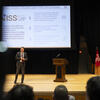
Tim Renick, executive director of the National Institute for Student Success, presented to more than 100 Temple University faculty, staff and administrators during a recent visit to campus.
Photo by Ryan S. Brandenberg
On Monday, Oct. 5, Tim Renick, executive director of the National Institute for Student Success (NISS) at Georgia State University, stood before a crowd of more than 100 Temple University faculty, staff and administrators from atop the stage of the Temple Performing Arts Center.
For the last several months, Renick and NISS have been gathering data and auditing Temple’s operations and practices that directly impact student success outcomes, and this marked the first time that Renick would be sharing his team’s findings with members of the Temple community.
“What we wanted to do was to better understand what’s happening to your students (in terms of retention),” Renick said. “Through this process, we have identified four challenges for Temple. The good news is that I believe you have every ability to address every one of these challenges. I am completely confident that you can make a huge difference.”
Over the course of 90 minutes, Renick shared the results of NISS’ diagnostic report before then outlining a playbook of Temple-focused actionable recommendations that will help improve student success outcomes. The presentation was the result of a partnership between Temple and Georgia State University, which was forged through the institutions’ membership in the University Innovation Alliance (UIA).
Housed at Georgia State, NISS’ mission is to help colleges and universities identify and resolve institutional barriers to college completion by increasing their capacity to implement proven and scalable student success solutions. Georgia State was one of UIA’s founding members, and in many ways, NISS grew out of the Alliance.
“Our students' ability to succeed cannot depend on knowing which office owns a process. If our systems make it harder for students to succeed, then we must change those systems,” said Temple President John Fry at the start of Renick’s presentation. “I have a great deal of optimism because I know how devoted we are to the welfare and success of our students.”
The release of the NISS’ diagnostic report and playbook comes approximately nine months after the launch of Temple’s strategic plan, Forward with Purpose, which has identified student success as its keystone priority. The intentional focus on that priority is part of the university’s concentrated effort to boost student retention and ensure students persist and graduate.
“That is a great thing about this. There is playbook alignment with Temple’s strategic plan,” said Renick during his talk.
As part of the presentation, Renick outlined four key challenges facing Temple that came to light during the audit process, specifically
- untapped potential in first-year support,
- insufficient access to and use of data to support students,
- inconsistent academic advising, and
- limited financial wellness interventions.
He also identified four immediate ways for how Temple and its administration can combat the challenges, citing
- enhancing the first-year experience;
- systematically collecting and assessing academic data;
- standardizing advising systems, protocols, training and practices; and
- scaling financial aid-related tags and alerts to track student financial risk.
As he shared these recommendations, Renick discussed the need to use data to help support students on their educational journeys. As an example, he mentioned that by identifying students who earn a D, F or withdraw (DFW) from a course, Temple can proactively reach out and closely advise them when they take the course a second time.
The data can be especially helpful for identifying themes of barrier courses, so appropriate interventions can be implemented to help students be more successful.
“You’re not going to improve your retention rates if part of your strategy is not addressing your DFW rates,” Renick said.
One of the Temple faculty members in attendance for Renick’s talk was Kimmika Williams-Witherspoon, professor and senior associate dean in the School of Theater, Film and Media Arts.
“The NISS event was sobering. Some of the data and analysis that Dr. Timothy Renick and his team provided coincided with a lot of things that some of us have been thinking about since COVID, and the drop in enrollment that we have seen in recent years. If our goal is not just to admit students but to retain them, we have to think about the institutional bureaucracy that often constrains students—particularly first gens, who may not readily know how to navigate the various systems,” Williams-Witherspoon said. “As a mother of a Temple alum, I am excited about encouraging programs to look clearly at the barriers that they may have erected over time through prerequisites, inconsistencies in advising and service, or math and English placements and that don’t count towards graduation but add on to student loan debt. The slide that had the most impact for me was the one that showed, when universities remove the barriers, that all students—white, Black, Hispanic and Asian—complete their studies and graduate at the same rates. If that’s not a motivator for change, I don’t know what is.”
Some of the recommendations from the audit are already underway. For instance, this summer, guided by the NISS diagnostic, Student Affairs, Enrollment Management and Academic Affairs worked to redesign the first-year experience for new students, and implemented changes to New Owl Orientation. It is one of the first ways the university has created a more coordinated approach to Orientation, advising, communication and student support.
The reimagined first-year experience is the first step of many that must be taken in the months to come as Temple works to implement NISS’ playbook of recommendations. However, following the Monday session, it is clear that there is optimism for what comes next.
“The diagnostic and playbook for Temple presented by the National Institute for Student Success provides a clear, practical and evidence-based roadmap for improving student retention and student success,” said Mike Bognanno, professor of economics and chair of Temple’s Faculty Senate. “I was impressed by the report. Implementing its recommendations will require a major effort, but it is necessary and will lead to meaningful improvements, like those achieved at Georgia State University.”
