
Laura H. Carnell Professor of History Bryant Simon explores the history of public bathrooms in his new book For Customers Only: Public Bathrooms and the Making of American Inequality. The book will be released Sept. 8.

Bryant Simon's book, "For Customers Only: Public Bathrooms and the Making of American Inequality," is the first book to tell the larger history of public bathrooms in the United States.
Photo by Joseph Labolito
Take a trip through history. Revisit every social movement of our time. Regardless of cause or origin, you will find that they all lead to the same destination.
The public restroom.
That is one of the key takeaways that Bryant Simon, Laura H. Carnell Professor of History within Temple University’s College of Liberal Arts, learned while conducting research for his forthcoming book For Customers Only: Public Bathrooms and the Making of American Inequality. The book, which will be released Sept. 8 by the University of Chicago Press, is the first book to tell the larger history of public bathrooms in the United States.
“Very early on in this process, I discovered that every social movement had a moment where they launched protests at bathroom doors. So the gay rights movement, civil rights movement, homeless rights and trans rights all share this distinction,” Simon said. “Public bathrooms were used to exclude people and make them less equal, and that's why the protests happened.
"Through my early research, I realized that I was not really looking at public bathrooms but instead a new way to think about equality and inequality in America.”
The book has already garnered considerable attention, generating several positive reviews, including this one from Heather Ann Thompson, author of Blood in the Water: The Attica Prison Uprising and its Legacy and a former Temple faculty member. “Simon's brilliant latest shines new light on the startling ways in which our most basic bodily functions became ground zero in this country's slow and steady move to privatize public space, to exacerbate racial and class inequality and to gatekeep morality. This most intimate cultural, political and unsettling urban history is both masterful and a must read,” writes Thompson.
At its core, Simon’s new book is a historical account about politics, discrimination, corruption and power in America. It follows the cloud of controversy that has hovered over public restrooms from their inception in the late 19th century, outlining a harsh reality that has proven true time and time again: If you want to make a person feel less equal, take away their bodily needs. The easiest way to accomplish that might be through a public bathroom.
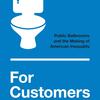
For Customers Only: Public Bathrooms and the Making of American Inequality will be released Sept. 8 by the University of Chicago Press.
Photo courtesy of Bryant Simon
“That is the thing with public bathrooms. It is not just a matter of laws; it is a matter of your body,” Simon said. “So think about what it meant to be Black in the 1940s. There was the humiliation of segregation, but it also meant that you were excluded and unable to take care of an essential need because there were so few restrooms almost anywhere, and if there was one, they were not open to Black individuals.”
Or, if the bathroom was open, you might not want to use it. One of the cases that Simon discovered through his research was an incident that occurred in Atlanta during the 1940s. A Black janitor was instructed by his white supervisor to not clean the Black bathroom, to leave it purposefully dirty.
“Unfortunately, more and more stories like this came up throughout my research,” Simon said.
According to Simon, the majority of public restrooms eventually closed. Local governments no longer wanted to deal with them being occupied by the homeless and/or used as hot spots for drug use. That then led to a more privatized approach and greater inequality. If someone does not make a purchase at a private business, they often are not allowed to use the restroom.
“The government gets out of the business of public bathrooms, but the thing is, people still need to go to the bathroom. Starbucks kind of figured out right away that bathrooms matter. Starbucks bathrooms were never like the ones at McDonald’s. This is a luxury of space, and basically what happens is that the company figures out, whether by design or by accident, that they can make money on the failure of the public sphere. If I really need to go to the bathroom, I’ll buy something. It’s an absurd proposition because flushing a toilet costs them what, a penny?” said Simon, who is also the author of Everything but the Coffee: Learning about America from Starbucks.
In his latest book, Simon argues that one of the ways that the government could work to best meet the needs of the public is through the construction of public restrooms. From his perspective, it is a way for the local government to demonstrate how it cares about its public, and it could potentially be leveraged toward larger initiatives focused on equality.
In Philadelphia, that work may be already underway. According to Simon, other cities are building new public bathrooms in their downtowns, often in an attempt to contain the homeless and their bodies. Philadelphia, however, is taking a different approach, choosing to build public bathrooms directly in neighborhoods.
“This is the type of thing that other cities need to be looking at,” Simon said.
Coincidentally, the one bathroom is in a neighborhood where Simon’s son routinely plays basketball. It’s already serving its intended purpose.
“He plays a lot of basketball,” Simon said. “He told me he can hoop all day because he doesn’t have to run home to use the bathroom. This is filling a need exactly as it should be.”
