Two-time Temple alum Adjoa Asamoah, CLA ’98, EDU ’01, recently visited her alma mater where she discussed her Temple path and encouraged attendees to be the change they want to see in the world.

Adjoa Asamoah is pictured with Emeritus Professor Abu Abarry during her recent visit back to Temple. Abarry served as one of her professors when she previously studied at the university.
Photo by Timothy Welbeck
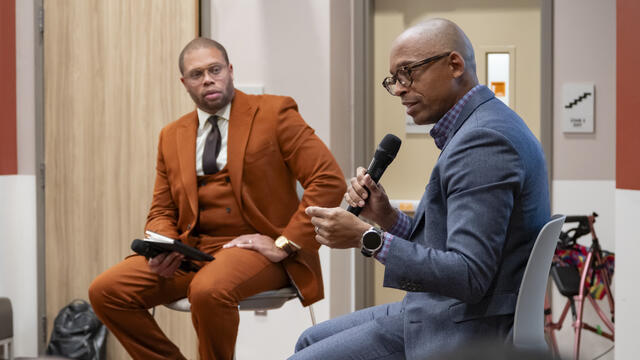
At the conclusion of a recent talk held before nearly 100 students, faculty, staff and community members on Temple University’s campus, Adjoa Asamoah, CLA ’98, EDU ’01, began fielding questions from the audience.
One attendee asked Asamoah how she stays so committed to her work. Another asked for her perspective on what makes voting so important.
After several questions, high school student Leilani Welbeck approached the microphone for the final question. While at the podium, the sophomore expressed concern over the challenges plaguing the world and asked for Asamoah’s advice on how to combat them.
Asamoah’s response was emphatic.
“Do not wait for other people to do what you are supposed to do,” said Asamoah, who also emphasized how as an aspiring engineer, Welbeck will be well-equipped to solve some of the world’s most complex issues. “You are the answer. If you see a problem, you already know what you must do.”
This notion of persistence and resilience was one of the key themes emphasized during Asamoah’s talk, which was held Nov. 19 at Temple’s Center for Anti-Racism (CFAR). The talk was part of the IDEALLY Speaking series and coincided with CFAR’s third anniversary. Past speakers for the series have included National Book Award-winning historian Ibram X. Kendi, CLA ’07, ’10; Princeton University Professor of African American Studies and Public Affairs Khalil G. Muhammad; and New York Times bestselling author Nic Stone.
A two-time Temple University alum, Asamoah previously worked as a political strategist on former President Joe Biden’s 2020 presidential campaign, and she has helped sponsor the Creating a Respectful and Open World for Natural Hair (CROWN) Act. Also known as HB 439, the legislation was recently signed into law in Pennsylvania.
During her talk, one of the other key topics of discussion was Asamoah’s connection to her alma mater.
“In so many ways, one of the pivotal stops in your journey was here at the nest,” said CFAR Director Timothy Welbeck, who took part in the discussion with Asamoah. “So, I’d love to know, how did your experience here shape you?”
Asamoah responded that the university was instrumental in her development, and it is clear that its influence is still ever prevalent.
“Everything that I am, I was prepared in part for because of my time spent here,” she said. “I am a proud two-time Temple alum because I owe so much to this university. In the press release that announces the passing of the CROWN Act, it notes that I am a Temple alum. That is what this place means to me.”
Asamoah also encouraged those in attendance to remain civically engaged, even when that is something that is easier said than done.
“Sometimes, you’ll be right, and you’ll be ahead of the game,” she said. “So, what are you going to do to move society forward? That is my official charge for you all. What I need is, I need for you all to be Owls.”