
More than 200 people participated in the annual Temple Ambler Campout.
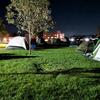
Photo courtesy of Temple University Ambler
The annual Temple Ambler Campout is not only a night of camping, stargazing, orienteering, discoveries and songs around the campfire. It’s an opportunity to connect people and groups with one another and the natural world around them.
Cold and blustery weather didn’t chill the spirits of the more than 200 people that spent the crisp weekend of Oct. 17–Oct. 18, 2026, engaging in many of the unique experiences that Temple Ambler and Temple University provide.
“The Temple Ambler Campout is a welcoming camping experience for beginning and experienced campers alike. Our campout is designed with families in mind who may have never tried camping and want to get that experience without having to trek out into the wilderness,” said Kevin Orangers, Temple Ambler deputy director and Ambler Campout co-coordinator. “For experienced campers, this is a way to explore a different type of camping—how often do you get to camp on a college campus—and often these participants share their knowledge with our more novice campers.”
At Temple Ambler, while participants were able to enjoy camping under the stars, they didn’t need to worry about “roughing it” too much, said Ambler Arboretum Director Kathy Salisbury.
“I think this is part of what makes this event special. It takes some of the discomfort out of a new experience and allows people to focus on connecting with nature,” she said. “Camping brings you closer to nature and helps you build connections with the world as a whole.”
Campers had the opportunity to explore the arboretum and the Tyler School of Art and Architecture Greenhouse Education and Research Complex; learn camping basics from the Appalachian Mountain Club Delaware Valley chapter; take part in day and night orienteering with the Delaware Valley Orienteering Association; experience a flight simulator with the College of Engineering; see how a drone operates up close with the College of Science and Technology’s (CST) Laura Toran; have a sing-along with Boyer College of Music and Dance senior music education student Andrew Malick; stargaze with the Delaware Valley Orienteering Association, Delaware Valley Amateur Astronomers and the Bucks-Mont Astronomical Association; and, of course, make s’mores!
“In addition to a terrific camping experience and an opportunity to connect with nature, visitors learn firsthand about some of the unique educational opportunities our students are involved with not only at Temple Ambler but Temple University as a whole,” said Holly Lynn, assistant director of campus and student engagement and Ambler Campout co-coordinator. “Campers saw the Temple Formula Racing car in person; learned about CPR and first aid from the Department of Nursing in the College of Public Health; experienced a pit firing and a kiln built by Tyler Ceramics students fired for the first time; and went on forest bathing walks with Caroline Burnell, director of the Institute on Protective Services at Temple Harrisburg.”
The campout was also held in tandem with the Ambler Arboretum and Temple Ambler Field Station BioBlitz. BioBlitz tours—offered by experts at Tyler, CST, the Ambler Field Station and the Ambler Arboretum—highlighted the many living species that call the Ambler Campus home, from amphibians and reptiles to insects and herbaceous plants.
Biodiversity “is all around us,” said Mariana Bonfim, managing director of the Ambler Field Station.
“I think visitors are very surprised at what they discover living right here in their community,” she said. “The BioBlitz is a chance for people to explore the campus in a completely different way, but I hope it also gets them thinking about the biodiversity in their own backyards and what they can do to support increased diversity.”
Chris Agard, assistant professor of instruction in biology at CST, helped campers learn about “creepy crawlies” such as reptiles, amphibians and insects, all species he is currently researching on campus.
“Whether you’re looking at the stars or looking at insects or snakes or lizards, it’s hands-on and, for some people, it might be just a little bit scary but the kind of scary, the kind of thrill, that keeps you engaged,” he said. “It’s the sort of thing that helps folks in the community become advocates for nature, for science, for the environment, because they had a good time and want to keep engaging in those experiences—that’s gold right there!”


