
Eric Albers and Rob Oakley, alumni from the College of Science and Technology’s Mathematics Department, are putting their analytical expertise to work, helping shape the decisions behind one of Major League Baseball’s most successful teams.
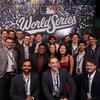
Rob Oakley (first row, far right), Eric Albers (third row, far right) and the Brewers' research and development staff were in Tampa Bay for the team's World Series victory.
Photo courtesy of Rob Oakley
It wasn’t until the Milwaukee Brewers secured the final out in game five of the World Series that Eric Albers and Rob Oakley allowed themselves to believe it. Years after studying mathematics at Temple, never imagining careers in professional baseball, the alumni are World Series champions and key members of the research and development department that helped clinch the franchise’s first-ever title.
“We had come really close the night before, so nothing felt guaranteed, but the energy was really good going into game five,” said Albers, CST ’19, the Brewers’ assistant director of baseball research and development.
“As the game went on, it became more clear that we were going to win,” added Oakley, CST ’25, senior analyst of baseball research and development. “We were all looking at each other like, can you believe this is really going to happen?”
The duo are products of Temple’s mathematics program. Albers earned his BS in 2019, and Oakley earned his PhD in 2025. They now find themselves in one of the largest and most ingrained analytics departments in the MLB.
Where data meets baseball
When most people think of sports analytics, they think of the 2011 film Moneyball, which popularized the Oakland Athletics’ pioneering approach to using data and statistics to find and sign undervalued players.
While evaluating players is still a core component of the work they do, Albers and Oakley say that analytics are integrated into nearly every area where data can be used to make the team better.
“Not only do we want to find undervalued players and sign them to the Brewers, but we also want to train our players to be as good as possible,” said Albers, who interned for the team in 2021 and joined full time in 2022. “Anywhere data can be helpful, someone from R&D at the Brewers is involved to an extent to help analyze trends and make our decision-making process better.”
Albers’ role has recently shifted toward recruitment and managing a team of analysts, but he spent his first three seasons with the team focusing on helping players improve their defense and baserunning, two areas that have become important to the Brewers’ identity and success.
Oakley joined the team full time in 2025, at a time where MLB teams were becoming more interested in data sources like bat tracking and biomechanics. Bat tracking measures the speed, path and angle of a player’s swing, while biomechanics measure how a player’s body moves during their swing.
Oakley works with data like these to improve players’ batting performances.
“I’m more focused on the player development side,” said Oakley, who also interned for a year before joining the Brewers full time. “How can we make our major league players better? How can we make our minor league players better? We’re using a lot of the more granular data that we collect to help make those decisions.”
From campus to the clubhouse
Neither Albers nor Oakley imagined they’d end up working in baseball. They thought they would follow the more traditional academic track of pursuing postdoctoral work and becoming math professors.
But after encountering a tough academic job market and realizing there were more sports-focused data science jobs available than they anticipated, they were willing to accept internships with the Brewers.
Both are big fans of baseball, but they said you don’t need a sports background to be a strong candidate for an analyst position with the Brewers. Their main advice to students looking to get into sports analytics is to study something difficult that they’re interested in.
They also said internships are a great way to get a foot in the door and figure out if sports analytics is a good fit. The World Series champions are currently hiring interns for next season.
“We’re looking for people who are really passionate and can explain how deeply they’ve thought about the work they do,” Albers said. “If you can do that, then I can help focus your work on baseball, if this is where you want to be.”
No offseason for analytics
Albers and Oakley were in Tampa Bay to watch the team’s World Series clinching win on Oct. 28.
Any diehard sports fan will talk about the stress they experience watching their favorite team play. The alumni said the stress is on another level when you work for the team. That intensity ratchets up even more during the playoffs.
“I genuinely feel like the two of us, and everyone here at the Brewers, were a huge piece in making this season happen,” Albers said. “But at the same time, you can’t do anything when you’re watching the game. You just have to trust that the coaches are going to use the information you gave them and make the same decisions you would. You have to trust that the players are going to perform. It’s a very odd experience to have something so important to your career’s success, but yet to have so little control over the actual outcome.”
Albers and Oakley attended the Brewers’ championship parade on Oct. 30. It was another opportunity to recognize their contributions to the historic season. But research and development never stops, and the Temple alumni are back at the office preparing to defend their title in 2027.
“It feels incredible, but now we have to go back to work,” Albers said. “Free agent signings could happen any time now. We have to make sure our tools are ready to help our front office make decisions and put a competitive team on the field next season.”
