
The new name is in recognition of a generous naming gift from Michael Spolan and the Spolan Family Fund. Once open, the Spolan Center will serve as the centralized home for all of Temple’s community engagement efforts.

Thanks to a generous gift from Michael Spolan (shown at right), the Burk Mansion will now be known as the Spolan Community Engagement Center, which will serve as a multiuse university-community hub.
Photo by Ryan S. Brandenberg
Directly across the street from the Burk Mansion is Progress Plaza, the nation’s first Black-owned shopping center. Less than half block down the street is the Columbia North YMCA. Just a little further down Broad Street sits New Freedom Theatre, Pennsylvania’s oldest African American theatrical institution.
In every way, the Burk Mansion is embedded directly into the North Philadelphia community, making it the ideal location for Temple University to further its commitment to serving its neighbors.
Today, the university announced its plans for the facility during a special gathering held at the Burk Mansion. During that event, Temple President John Fry shared that in recognition of a generous naming gift from Michael Spolan through his Spolan Family Fund, the Burk Mansion will now be known as the Spolan Community Engagement Center.
“There are a total of five zip codes that surround our Main and Health Sciences Center campuses, and more than 175,000 people call those areas home,” Fry said. “They are more than our neighbors, they are vital members of the Temple University community, and it is imperative that we strengthen our commitment to them in support of our strategic plan and the priority of Place-based Impact.
“The Spolan Community Engagement Center will serve as a multiuse university-community hub that will leverage Temple’s expertise and talent to serve our neighbors,” Fry added. “We are deeply grateful to Michael Spolan and the Spolan Family Fund for their incredible generosity, which will allow us to expand our community engagement efforts and further our impact.”
Renovations have already begun at the Spolan Center, with plans for the facility to open to the community in early 2028.
Once open, the center will serve as the dedicated hub to house Temple’s community engagement efforts. It will host a range of programs and services that will be available to the North Philadelphia community.
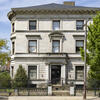
After sitting vacant for more than 30 years, the Burk Mansion will now find new life as the Spolan Community Engagement Center, a dedicated hub to house Temple’s community engagement efforts.
Photo by Ryan S. Brandenberg
Located at 1500 N. Broad St., the Burk Mansion, constructed in the Italian Renaissance Revival style, was built in 1907 by business magnate Alfred E. Burk. It is one of the last surviving historic houses in Philadelphia built by wealthy industrialists during the late 19th and early 20th centuries.
It was first designated by the Historical Commission as a historic site in January 1971, which is also the year in which it was acquired by Temple. The mansion also was included in the American Buildings Survey of the Library of Congress in July 1973.
In the late 1960s, Temple’s School of Social Administration, through its Center for Social Policy and Community Development, began providing community education, workforce development, violence prevention, child welfare training, a childcare center and other programs for the community. For decades these programs were housed in the mansion, however, it has been vacant since 1995. In 2012, the university invested in the stabilization of the mansion and conservatory to help preserve it for future use, but a definite plan for the building’s future had not been developed until this past spring when Temple submitted a formal application to the Philadelphia Historical Commission on how it plans to rehabilitate and use the facility moving forward.
The new life that the mansion will take on as the Spolan Center is especially significant for David Brown, Temple’s executive director of community impact and civic engagement, who will lead the university’s community efforts at the newly renovated facility.
“We are looking at the Spolan as a literal extension of the university into the community. We are in active discussions with our schools and colleges along with community partners—all of which we anticipate will be offering programs there,” Brown said. “The intentionality of the way that we are going about this is really special. Here, we have a historically certified treasure, and we are transforming it into something that could both lift the community and extend our mission as an educational institution. It’s profound."
Moving forward, Brown and his colleagues plan to take a listen-first approach as they work to map out what programs and initiatives will operate out of the Spolan Center. Some programs, like Temple’s Community Gateway, have already been identified as programs that will move to the center.
Community feedback will help inform many of the other needs that the Spolan Center will look to meet. Brown also hopes to explore partnerships with many nearby organizations such as the Columbia North YMCA.
“We have some significant plans for what it will be, but the most important thing that we’re going to start doing is really listen to the community, so we can learn what they want to see in the building,” Brown said. “The beauty of it is that we’re somewhat in a blank canvas stage, and we hope to paint a picture that’ll enable the community to really rise in terms of fulfilling the needs that are not currently being met.”
