
During this event co-sponsored by Temple Libraries, de Waal spoke about the role of collections, archives and memory in his work. Following the talk, Dean Joe Lucia engaged in a conversation with de Waal and Craig Dykers, founding partner of Snøhetta, the firm that designed Charles Library.
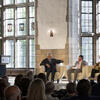
Temple held a public lecture with distinguished artist and writer Edmund de Waal, followed by a conversation with Temple Libraries Dean Joe Lucia, de Waal and Snøhetta founding partner Craig Dykers.
Photo by Ryan S. Brandenberg
At 17, Edmund de Waal ran away from school in England to become a potter in Japan. Little did he know that this decision would lead to an inheritance from his great uncle Ignace “Iggie" Ephrussi of 264 netsuke—small, exquisite Japanese wood and ivory carvings.
This collection, which inspired de Waal’s lauded bestselling memoir The Hare with Amber Eyes: A Hidden Inheritance, served as a point of emphasis during his public lecture at Temple in Mitten Hall on Sept. 14.
In the book, de Waal traces his family’s history through the collection of netsuke, traversing 19th-century Paris to 20th-century Vienna and then post-World War II Tokyo.
Sponsored by Temple Libraries, the event featured the internationally renowned artist and writer reflecting on his work, which explores memory, collections, archives and the movement of objects through time. De Waal also engaged in a conversation with Temple Libraries Dean Joe Lucia and Craig Dykers, founding partner of Snøhetta, the firm that designed Charles Library.
“Programs like today’s are emblematic of Temple’s mission, which is bringing individuals and ideas together across disciplines, institutions and communities,” said President John Fry. “This is what thoughtful and civil discourse looks like, and we should practice it together every day.”
Highlighting the role of libraries in his artistic practice, de Waal also described projects from his Library of Exile installation at the 2019 Venice Biennale and his most personal commission at the Musée Nissim de Camondo in Paris, an archival place of recovery.
“Libraries preserve knowledge and they preserve lives through the books people choose to collect and the histories they pass from one generation to the next. Edmund has the ability to see the connections and contradictions within these histories and give them form and voice with sensitivity and elegance,” said Hana Iverson, curator in residence at Temple Libraries.
Through his work, de Waal considers how objects and images carry histories across generations and how collections themselves hold layered voices, absences and possibilities for reinterpretation.
His use of kintsugi—a Japanese technique that restores broken objects such as ceramics and glass with gold—exemplifies this reimagination.
“For me, this practice isn't about repair," said de Waal. "You can't repair, but what you can do is show where loss has happened. This threading with gold shows where loss has occurred so that you can pick up again."
During the event, De Waal, Lucia and Dykers engaged in a broader conversation about libraries, including how they're structured and how people experience them.
“Throughout the discussions that shaped the concept and development of Charles Library, we understood it to be much more than a building,” said Lucia. “We envisioned it as a place that could reshape intellectual and cultural life of a university where new ideas and unexpected collaborations could take form, bringing together people with different ways of thinking that might not otherwise meet.”
Dykers spoke about relying on natural conditions like daylight when designing the building. “This daylight is part of the simple geometry of circles, which have tremendous power," Dykers said. "In Charles Library, you see circles everywhere. The circle embraces, and it’s also about the cycles of life: You begin, you end and you go back to where you began. People can relate to this concept no matter where they’re from."
Snøhetta has also designed structures such as the Bibliotheca Alexandrina, Norwegian National Opera and Ballet, Beijing Library, Calgary Central Library, Far Rockaway Library in Queens, James B. Hunt Jr. Library at North Carolina State University, and Theodore Roosevelt Presidential Library in North Dakota.
De Waal expressed amazement at the design of Charles Library. “One of the joys for me was running my hands along the extraordinary cedar of the library. The way the sun was shining into the oculus was also beautiful.”
He also commended its utility and impact.
"Books are objects, and the way you represent the scale of a library and the opportunity to encounter books is important,” added de Waal. “I was in awe of the BookBot and thought ‘this is the future,’ and at the top of the building, there are hundreds of books in the stacks. What I want from a library is to go across the threshold and be welcomed. You’ve done that at Charles Library.”
