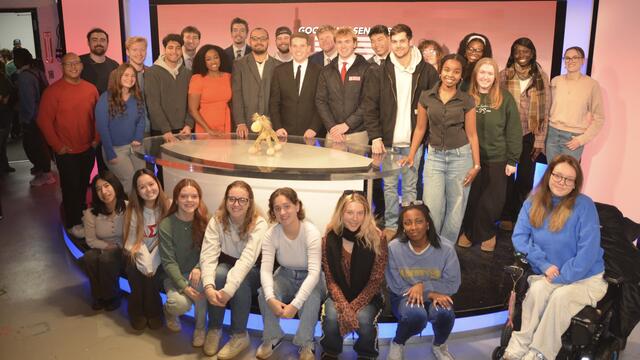
Latty is the first educator to win the award, which honors a trailblazing journalist who carries forward the legacy of Gwen Ifill, the longtime co-anchor of PBS NewsHour.
Yvonne Latty is the 10th recipient of the Gwen Ifill Award. The award recognizes Latty for her transformative mentorship and commitment to expanding diversity in investigative reporting.
Photo by Ryan S. Brandenberg
Growing up on the edge of Harlem, Yvonne Latty would spend hours sitting on her family's fire escape watching stories unfold in the neighborhood below. She was an observer of people long before she became a journalist.
Decades later, after a career spent reporting on underserved communities and guiding hundreds of young reporters, Latty has been recognized with the Gwen Ifill Award for her mentorship and commitment to expanding diversity in investigative reporting.
“It's very emotional. It makes me think a lot about all the people who helped me and all the obstacles I had to face to be here,” said Latty, professor of journalism at the Klein College of Media and Communication and director of Klein's Logan Center for Urban Investigative Reporting.
Established in 2017 by the International Women’s Media Foundation (IWMF), the Gwen Ifill Award honors a trailblazing journalist who carries forward the legacy of Ifill, the longtime co-anchor of PBS NewsHour. Latty is the first educator to win the award.
“Yvonne is the rare kind of journalist who not only creates profound, changemaking reporting but also passes that skill and knowledge on to young journalists following in her footsteps,” said Elisa Lees Muñoz, president of the IWMF, in a Sept. 10 news release.
For Latty, the award is the product of her upbringing and the mentors and friends she's made throughout her career. She credits her dad for teaching her about the power of journalism.
“My dad used to read two newspapers a day and watch TV news, and he always would talk to me and my sister over dinner about whatever the story of the day was,” Latty said. “If you're not a part of that narrative, you're invisible. I wanted to be a journalist because I wanted to tell stories of underserved communities, and I wanted to make sure that people saw these neighborhoods the way that I did.”
Latty began her career at The Reporter Dispatch, a daily newspaper in White Plains, New York, where writing two stories a day taught her to report quickly and under pressure.
She later spent more than a decade covering crime and homicides for the Philadelphia Daily News, now part of The Philadelphia Inquirer.
“I met some incredible people working on those stories who just moved me beyond words and showed me what real heroes are,” Latty said. She credits her former colleagues at the Daily News, including Pulitzer Prize winner Barbara Laker and city editor Jackie Jones, for shaping her into a stronger journalist.
Latty left the Daily News in 2006 to direct journalism graduate programs at NYU's Arthur L. Carter Journalism Institute. There, she focused on preparing the next generation of journalists while bringing more diverse perspectives into newsrooms.
“I made it my mandate to recruit people of color and give them opportunities to study at such an amazing university,” she said. “I'm incredibly proud of the careers so many of them have gone on to have.”
Her former students now work in some of the highest caliber newsrooms in the country, including CNN, The New York Times, NBC and The Washington Post.
In 2022, Latty came to Temple to lead the Logan Center. She was such a perfect candidate for the job that David Boardman, dean of Klein and the university’s chief strategy officer, couldn't believe she was available.
“I trusted her fully in that role because she matched our vision of the center so well,” said Boardman, who served as executive editor and senior vice president of The Seattle Times before coming to Temple.
During his career, Boardman watched investigative journalists report in unfamiliar communities before moving on to the next story. Too often, he said, those communities felt worse off than they did before.
With the Logan Center, Boardman and Latty sought to teach a new approach to investigative journalism—one that elevates and engages with the community throughout the entire process.
The center has since reported on stop-and-frisk policies and youth homelessness in Philadelphia. Last April, the center partnered with The Philadelphia Inquirer on a podcast series marking the 40th anniversary of the MOVE bombing.
“No other institution in America is preparing students for careers in investigative journalism this way. Yvonne, Klein and Temple truly are trailblazers,” Boardman said.
Most recently, the Logan Center teamed up with WHYY's Cherri Gregg, KLN ’12, for a podcast series that explores how prison breaks down the bodies of incarcerated women.
“Yvonne has spent her career proving that investigative journalism can be both uncompromising and deeply humane,” said Gregg. “She has shown that university-based journalism can be rigorous, impactful and rooted in public service. She is one of the finest journalists I have ever worked with, one of the most generous mentors I have ever known and one of the most principled people in our profession.”
As Latty reflects on her award-winning career, her future plans remain simple: continue telling stories that matter to people.
“I've never thought about the next big thing I want to accomplish,” she said. “I just want to stay open, listen, and respond to things that need to be investigated and reported on. We've had a great year at the Logan Center. I want to keep helping students tell stories that make them proud and that also serve the community.”