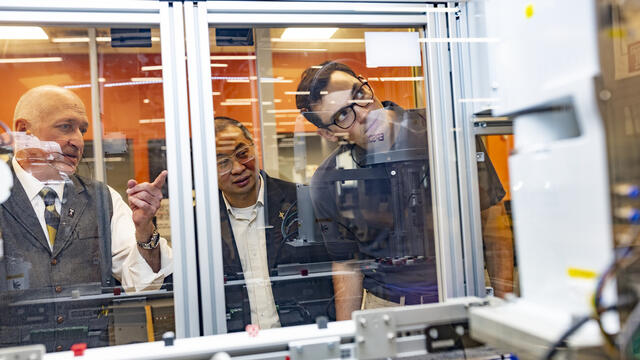
As a founding member of Pennsylvania’s Keystone AI + Quantum Factory, Temple is helping advance AI and quantum research while preparing the workforce of the future.

Through Pennsylvania’s new Keystone AI + Quantum Factory, Associate Professor of Computer and Information Sciences Xinghua Mindy Shi aims to develop an agentic AI system capable of continuously …
Photo by Ryan S. Brandenberg
What if we could better anticipate how a disease like Alzheimer’s evolves and guide more personalized care decisions before conditions worsen? That question is helping drive work at Temple University, where Xinghua Mindy Shi, associate professor of computer and information sciences at the College of Science and Technology and the Institute for Genomics and Evolutionary Medicine, is tackling one of healthcare’s most difficult challenges: predicting and managing dementia progression over time. The bottleneck for her research? Computing power.
That limitation is now beginning to shift through Pennsylvania’s new Keystone AI + Quantum Factory, which Temple helped launch as a founding member. The statewide consortium brings together universities, industry partners and public-sector leaders to expand access to advanced computing infrastructure needed for large-scale AI and quantum research.
“This kind of computing infrastructure dramatically accelerates our research,” explained Shi. “Some of the large-scale AI training and simulations that might previously have taken us weeks can now potentially be scaled down to a couple of days or even several hours.”
Shi’s work is part of broader research activity underway across Temple, where faculty and researchers are exploring how AI, quantum technologies and advanced computing can be applied to pressing societal challenges.
“The Keystone AI + Quantum Factory is creating the kind of shared infrastructure that no single institution could build on its own,” said Josh Gladden, Temple’s vice president for research. “Research like Mindy’s demonstrates how access to advanced computing can help accelerate work on urgent challenges faced by society by supporting the scale of computing that today’s research demands.”
Advancing dementia care through technology
Shi’s research at the Keystone Factory, “Trustworthy Agentic AI for Personalized Dementia Management,” focuses on a central challenge in dementia and Alzheimer’s disease care: The disease develops gradually over many years, often producing incomplete, inconsistent and constantly changing signals that make it difficult to anticipate how a patient’s condition may evolve. Her work aims to develop an agentic AI system capable of continuously modeling a patient’s condition over time, accounting for uncertainty and helping guide more personalized care decisions.
With a background in computer science and machine learning, Shi has spent years applying advanced computing technologies to genomics and healthcare challenges. Dementia research, she explained, stood out because of both the complexity of the disease and the profound effect it has on patients and families over long periods of time, particularly as aging populations continue to drive rising rates of dementia worldwide.
“One of the biggest challenges with dementia and Alzheimer’s disease care is that patients and families often do not know what is coming next,” said Shi. “Symptoms can develop gradually over many years, and disease progression can vary from person to person. What we are building is a system that can continuously integrate information over time and learn evolving patterns, helping to improve disease management and care.”
To develop and refine the system, Shi’s team is training AI models using large-scale simulations and augmented datasets to replicate how dementia progresses across different patient populations. Those efforts will allow her team to test interventions, adapt strategies and refine models before they can be applied in real-world clinical settings. Shi emphasized that one important part of trustworthy AI is understanding uncertainty.
“In healthcare, it is not enough for a system to simply make predictions,” she explained. “Clinicians also need to understand how reliable those predictions are, when the system may be uncertain and where human oversight is still needed. That is a major focus of our work.”
While this research currently relies on advanced AI models and large-scale computing infrastructure, Shi said emerging quantum technologies could eventually help process and model increasingly complex datasets at an even greater scale.
Building talent and expanding applications
In addition to supporting cutting-edge research, the Keystone Factory is also designed to help prepare students and researchers for fields where AI, quantum technologies and advanced computing are becoming increasingly central. For Temple, that talent pipeline development mission is closely tied to research itself.
Students working on projects like Shi’s are benefiting from expanded access to the kind of large-scale computing power that is increasingly defining industry. That added capacity allows researchers and students to run larger simulations, process more complex datasets and pursue projects that can otherwise be constrained by computing limitations. “Initiatives like the Keystone AI + Quantum Factory help expand what we are able to do as computing demands continue to grow,” Shi added.
Pennsylvania Department of Community and Economic Development Deputy Secretary for Technology and Entrepreneurship Jen Gilburg said institutions like Temple are central to the consortium’s long-term goals around innovation, workforce development and economic competitiveness. “Temple University and other research institutions across the commonwealth will play an important role in helping Pennsylvania compete in rapidly evolving AI and quantum fields,” Gilburg said. “The Keystone AI + Quantum Factory is designed to turn research into new companies, high-quality jobs and economic opportunity across the commonwealth.”
At Temple, Gladden echoed these sentiments, emphasizing the importance of ensuring Temple researchers and students remain competitive in rapidly evolving fields that are transforming research and industry.
“This is about positioning our researchers and our students for where the field is going,” Gladden said. “The ability to work at this scale, with access to advanced computing and collaboration across institutions, is what will define the next generation of discovery and how quickly those discoveries translate into real-world impact.”