
Known as the “father of sports medicine,” Joseph Torg, MED ’61, transformed athlete safety through his research and advocacy as a physician.

Known as the “father of sports medicine,” Joseph Torg, MED ’61, transformed and advocated for athlete safety and inclusion through his research and career as an orthopedic surgeon.
Photo by Sameer Khan/Fotobuddy
Joseph Torg, MED ’61, orthopedic surgeon and sports medicine physician at Temple University Hospital, transformed athlete safety nationwide and advanced Temple’s reputation.
Known as the “father of sports medicine,” Torg dedicated his research and career to improving conditions for athletes on and off the field. In 1976, his research led high school and college football organizations to ban “spearing,” or initiating tackles with the top of the helmet, contributing to a dramatic decline in catastrophic cervical spine injuries and paralysis. Prior to the rule change, 34 football injuries resulted in quadriplegia annually on average. After the rule change, these catastrophic injuries fell to just three per year by 2000.
His research into head and neck injuries was the basis for concussion protocols adopted by the NFL, the NCAA and the NHL.
Also during the 1970s, he testified that it was safe for girls to play baseball in a case that paved the way for the gender integration of Little League Baseball.
While at Temple, Torg co-founded the Temple University Center for Sports Medicine and Science, the first of its kind affiliated with an academic institution. The center provided exemplary care to athletes and became a foundation for prolific research.
As part of Torg’s research and work in orthopedics, he promoted the Lachman Test—now considered best practice—for evaluating anterior cruciate ligament (ACL) instability. This test of the knee was taught by Torg’s mentor, John Lachman, MED ’43, then chair of orthopedics at Temple. Torg documented the technique in professional literature, solving the problem of the common failure to diagnose ACL injuries.
Additionally, his efforts brought much-needed attention to a foot injury that was easily missed, the tarsal navicular stress fracture. Working with Helene Pavlov, MED ’73, Torg developed a simple radiographic technique for diagnosing the injury—and importantly, identified non-weight-bearing management as the effective treatment. His research ultimately determined that the design of the seven-inch-long conical cleats on the bottoms of athletic shoes worn at the time were responsible for many knee and ankle injuries. Eventually, the soccer-type shoe, which demonstrated a marked decrease in these injuries, became standard, and the seven-cleated shoe was prohibited at both the high school and college level.
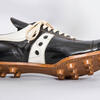
The cleat designed with the support of research by Joseph Torg
Photo by Colin Lenton
In 2018, he and his wife Barbara established the Joe Torg Scholarship Fund at the Lewis Katz School of Medicine. This gift provides full-tuition support for medical students with financial need who attended public, private or parochial schools in Philadelphia—students with backgrounds similar to Torg’s.
Katz unveiled an official portrait of Torg at a special ceremony in 2019.
Beyond Temple, Torg served as team physician for the Philadelphia 76ers, the Philadelphia Flyers and the Philadelphia Eagles, treating star players such as Doug Collins and Billy Cunningham. In the 1980s, he was the physician consultant for President Ronald Reagan’s Council on Physical Fitness and Sports.
In addition to caring for professional athletes, Torg provided pro bono care for Philadelphia public and parochial high school football teams as well as young children at St. Christopher’s Hospital for Children, Episcopal Hospital and Shriner’s Hospital for Children.
Aside from serving on Temple’s faculty, Torg worked at the University of Pennsylvania and the Medical College of Pennsylvania (now Drexel University College of Medicine), establishing sports medicine fellowship programs and conducting game-changing research. In collaboration with colleagues, he wrote 28 books and 42 book chapters and contributed to more than 150 articles.
Torg has also received numerous honors, including an induction into the American Orthopedic Society for Sports Medicine Hall of Fame, one of the field’s most prestigious achievements, in 2005. He was also named the Association of Fundraising Professionals’ 2018 Philanthropist of the Year by the organization’s Greater Philadelphia Chapter for his long-standing generosity to Temple, William Penn Charter School and Haverford College.
He played football at Central High School before transferring to William Penn Charter School. Torg then studied at Haverford College and turned to Temple to pursue a career in medicine. During medical school, Torg paused his training to serve two years with the Army Medical Corps in Germany and was honorably discharged with the rank of captain in 1968, the year he also completed his residency.
Torg passed away in 2022.
