
The 2025–2026 Research and Creative Works Symposium, a universitywide celebration of Temple’s innovative and impactful research, was held on Feb. 4 at Morgan Hall.
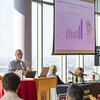
Temple is recognized as an R1 research institution by the Carnegie Classification of Institutions of Higher Education, given only to institutions that demonstrate very high research activity.
Photo by Ryan S. Brandenberg
Imagine if, from the moment of birth, a child saw a new image every 100 milliseconds without ever sleeping; it still would not see as many images as some artificial intelligence models until they turn nearly 40 years old. Yet a recent study found that 4- and 5-year-olds already perform on par with some of today’s most advanced AI systems, despite having hundreds of times less visual experience.
This striking comparison, suggesting that humans are far more data-efficient than current AI models and can form visual concepts with much less experience and uncover new insights into how the human mind words, was showcased by Vlad Ayzenberg, CLA ’12, assistant professor in Temple University’s College of Liberal Arts, during the university’s 2025–2026 Research and Creative Works Symposium on Feb. 4. The symposium brought together faculty from across Temple’s 17 schools and colleges to the 27th floor of Morgan Hall for a daylong celebration of the university’s interdisciplinary research addressing some of today’s most pressing scientific, social and cultural challenges.
“The research symposium reflects Temple’s commitment to translating discovery into impact—advancing health, equity, technology and community well-being,” said Temple President John Fry at the event. “We know that today’s most pressing challenges—health disparities, AI governance, biomedical discovery, environmental sustainability and workforce transformation—cannot be solved within a single discipline.”
Following Fry’s remarks, Josh Gladden, Temple vice president for research, highlighted the university’s remarkable research growth, noting that its total research and development expenditures have risen from roughly $124 million 15 years ago to over $315 million today. Gladden explained that part of that growth reflects investments in building the administrative systems, processes, policies, ecosystem and culture that support Temple’s status as a true R1 university. Over the last couple of years, much of their work has been focused on positioning the university to unlock its full research potential.
“The Research and Creative Works Symposium has become an important part of how we bring our research community together at Temple. Each year, it provides a shared space for faculty, students and staff to engage across disciplines, surface emerging areas of focus and strengthen connections that support future collaboration,” said Gladden. “It also strengthens institutional visibility and shared understanding of our research and creative activity, reinforcing the central role of scholarship in Temple’s mission as a public research university.”
Another speaker, Leora Eisenstadt, associate professor in the Department of Risk, Actuarial Science, Healthcare Management and Legal Studies at the Fox School of Business, shared her research on analyzing sexual harassment claims by using AI tools to uncover patterns and outcomes more efficiently. A challenge her team faced was that thousands of claim documents from more than 85 district courts were all categorized under a single civil rights code, providing no breakdown by race, age, disability, color, national origin or sex. By using GPT-4, they were able to analyze these documents more efficiently and detect nuances that a traditional keyword search could not. Her team has the goal to build a 10-year database of sexual harassment and sex discrimination claims nationally and house it at Temple, so scholars from around the country can come to the university to study trends and correlations.
Some of the other morning-session presentations included research on the use of artificial intelligence in genomic medicine, including harnessing remote digital biomarkers to detect and predict clinical changes in ALS, applying AI-based protein structure-prediction and design programs to cancer biology, and exploring the use of generative AI tools to advance biomedicine. It also addressed biomedical and clinical discoveries, such as FAM120A as a novel effector in the progranulin oncogenic axis in bladder cancer and a new approach to pain relief without the risk of addiction.
The afternoon sessions explored a broad range of research, from education and workforce equity to population health, behavior, and wellbeing, and also included innovations in engineering, robotics and intelligent systems; design, architecture and the human experience; environmental and policy justice; and emerging methods and translational technologies. Together, the research sessions align with the university’s recently announced Strategic Plan and mission.
“Altogether, this event both illustrates and underscores Temple’s ability to attract, retain and support high-impact researchers across career stages,” added Fry. “The symposium reflects Temple’s momentum and its readiness to lead in the next era of interdisciplinary research.”
