Research co-authored by Daniel Funk, professor from the School of Sport, Tourism and Hospitality Management, finds that supporters of sports teams often feel more socially supported and fulfilled.

Temple University research finds that people who strongly identify as fans of a sports team tend to experience greater social well-being.
Photo by Betsy Manning
When the Philadelphia Eagles fell to the San Francisco 49ers in the wild card round of this year’s NFL playoffs, their hopes of repeating as Super Bowl champions fell with them. Although Eagles fans (and fans of 29 other teams) won’t get to cheer on their team in Super Bowl LX, Temple University research suggests their fandom does leave them with one thing: improved social well-being.
In a study co-authored by Daniel Funk, professor and Ed Rosen Senior Research Fellow in Temple’s School of Sport, Tourism and Hospitality Management (STHM), researchers surveyed nearly 1,000 sports fans from the United States and United Kingdom about social benefits they’ve perceived through their fandom. They found that people who strongly identify as fans of a sports team tend to experience greater social well-being, because the group gives them a sense of purpose and meaning, shared norms about how members support one another, and trust in fellow group members.
“We found that when someone has a strong identity with a sports team, it makes them feel more positive about the place they live in,” said Funk, who joined STHM in 2011 and conducts research on sport consumer behavior and marketing. “It makes them feel more positive about the connections they have with others.”
The study, “Psychosocial resources linking consumer identification and social well-being: Integrating the social identity approach with transformative service research,” was published in the Journal of Business Research in June 2025. It was co-authored by Yuhei Inoue, FOX '11, and Mikihiro Sato, FOX ’14, from the University of Illinois Urbana-Champaign; Steve Swanson, FOX ’14, from Deakin University; Daniel Lock from Bournemouth University; and James Du, FOX ’17, from Florida State University.
“Social well-being is a feeling that you belong. It’s a feeling that you matter and that you function well in society,” Funk said. “People don’t really think about that, but sports can provide these kinds of social wellbeing benefits.”
The researchers discovered a link between social well-being and what they call consumer identification, which includes sport fandom, but can also impact other groups, like members of the same gym or nonprofit organization.
“We also call it team identification. Consumer identification is this knowledge that you belong to a group, and that this group is important to you,” Funk said.
Consumer identification is not someone who merely supports the Philadelphia Eagles by watching games and buying merchandise. Rather, consumer identification exists when someone sees themselves as part of a group connected to the Eagles, such as identifying as an Eagles fan.
“It’s not about your relationship with the Philadelphia Eagles. It’s about how you feel you belong with other Eagles fans, other group members,” Funk said.

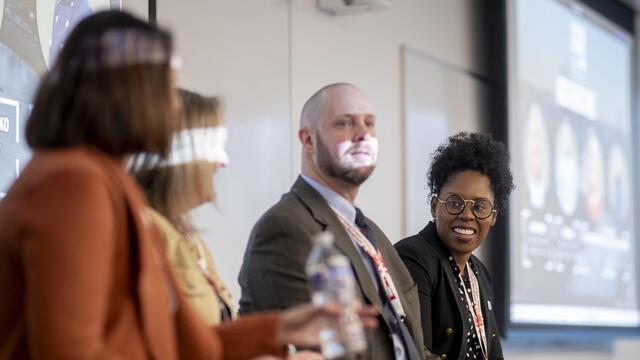
Daniel Funk is a professor and Ed Rosen Senior Research Fellow in the School of Sport, Tourism and Hospitality Management, where he also conducts research out of the Sport Industry Research Center.
Photo by Ryan S. Brandenberg
People identify with many kinds of groups, such as loyalty programs, fitness clubs and brands. But Funk says sports fandom has a unique ability to unite people from diverse backgrounds.
Unlike other groups organized around shared professions or interests, sports fan groups often create what Funk describes as a representation of society, uniting people from all walks of life through shared emotion and tradition.
“We belong to a lot of different groups; sometimes we don’t think they’re that important,” he said. “But a team identity is something you choose, and that feeling of belonging is what we’re really trying to tap into.”
What about fans of the Seattle Seahawks and the New England Patriots, who are set to compete in Super Bowl LX on Sunday, Feb. 8? Does a team’s success factor into the social benefits their fans experience?
“I certainly think success galvanizes interest from the media and social media,” Funk said. “When a team is winning, people are interested. There’s that hype, which tends to have a bandwagon effect. People want to jump on board.”
Ironically, Funk says that fan groups of perennial losing teams are arguably the strongest, because of the adversity they deal with. When a team has historically enjoyed very little success, only the most loyal fans remain. In the face of adversity, Funk says, those fans still have each other.
So regardless of whether your team is competing for the Super Bowl, got bounced in the playoffs or was eliminated from contention months ago, fans can enjoy the social benefits from following along.
“For the true, loyal fans, a loss may be disturbing,” Funk said. “They may experience an emotional low for a while, but that team is too important to them. The fandom, the friendships—it’s all too important, so they don’t sever.”