
Temple Professor Kathy Hirsh-Pasek appeared on Good Morning America on Jan. 27 to discuss the benefits of play on children’s learning and language development with an updated edition of her book, Einstein Never Used Flash Cards.
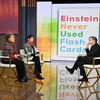
Temple professor Kathy Hirsh-Pasek (second from left) and collaborator Roberta Michnick Golinkoff speak with George Stephanopoulos on Good Morning America on January 27, 2026.
Photo by ABC/Paula Lobo
Parents today are overwhelmed with managing schedules, screen time and mounting expectations to do it all. Kathy Hirsh-Pasek, the Stanley and Debra Lefkowitz Faculty Fellow in the Department of Psychology at Temple University, offers a simple solution to slow down—play more.
It’s a message she’s been sharing for decades and one that feels more urgent than ever. Hirsh-Pasek, a developmental psychologist, has long been a champion of the benefits of play-based learning, backed by research that she conducts at Temple’s Infant and Child Language Laboratory. After 20 years of research, Hirsh-Pasek confirms that play is not only essential for children’s development but helps parents, too.
In her research and conversations with families, Hirsh-Pasek says the same concerns come up again and again.
“We hear all the time that parents are harried,” she said. “They are trying to manage so many things and now the effects of digital media on their children. We have to reset and remember the importance of play. We need to build more downtime into our schedules.”
Hirsh-Pasek shared this message on a national stage on Good Morning America on Jan. 27 to promote the new edition of her bestselling book, Einstein Never Used Flash Cards: How Our Children Really Learn—and Why They Need to Play More and Memorize Less with long-time collaborator and co-author Roberta Michnick Golinkoff from the University of Delaware.
The updated edition was released on Jan. 20, 2026. Originally published in 2003, the award-winning book is an evidence-based resource advocating that unstructured and guided play is a more effective way for children to develop critical, social and language skills rather than using flash cards or memorizing facts.
More than two decades later, the world children are growing up in looks very different. Much of that change can be attributed to the rapid advances in technology that have reshaped childhood since the book was first released.
“I’m not sure that parents or the world was in any way prepared for what was going to happen with the seismic change that the iPhone and the iPad made to kids’ lives,” she said. “We’re in a digital and AI-driven world now.”
Those shifts prompted Hirsh-Pasek and her co-authors to expand the book—the revised edition includes the latest research findings on how play supports learning and a new chapter on navigating digital media.
“The context in which children are growing up and in which parents are parenting is so different than when we first wrote the book,” she said. “So, with the new edition, I said we can’t just write a forward. It has to be up to date with the science. And it has to have a chapter on screen time. So that’s what we did.”
A senior fellow at the Brookings Institution and named a “scientific entrepreneur” by the American Association of Psychology, Hirsh-Pasek has dedicated her career to examining the development of early language and literacy and the importance of play.
She co-directs Temple’s Infant and Child Language Laboratory, focused on how children from 2 months to 10 years learn about the world they live in—with research on spatial development, memory, language development, reading and the role of play in learning. Decades of research have led her to a simple but often overlooked conclusion.
“Play is not frivolous,” she said. “Kids are discoverers and explorers in their world. Our research has found that the richest interactions for kids were always while they were playing. As we’ve come to study it and looked at the neuroscience of play and how the human brain learns, it turns out human brains learn in precisely the way that kids play. We found the best results for kids are if you marry the focus of a directed teaching approach with the joy of a playful learning approach.”
And, she adds, prioritizing play will help children build the life skills necessary to be successful adults in a digital age—especially in a workforce increasingly shaped by artificial intelligence.
“Play helps children learn so many valuable skills,” she said. “They learn what we call the six c’s: collaboration, communication, content, critical thinking, creative innovation and confidence. In the business literature today, we see that these are the skills that are needed in a time of AI. Computers will be faster than us and will know more facts than us. But they’re not going to know how to think, discover, create and explore.”
And, she says play can be more effectively integrated into the digital landscape to continue honing those skills.
“Digital tools are here to stay,” she said. “We have been doing a lot of work in the digital space to help people who design digital environments and digital products to incorporate play-based learning characteristics that are best for kids.”
Rather than resisting technology, Hirsh-Pasek wants to empower parents to help children effectively manage their digital media consumption. She compares that approach to teaching children healthy eating habits.
“We have a food pyramid that teaches our children how to have a balanced diet,” she said. “So, in the same way, our job is to help them learn what they need to have a balanced digital diet. If we can do that, we win as parents.”
Play should not just be reserved for children, according to Hirsh-Pasek. Ultimately, what she calls “playful learning” is also about fostering human connections in a disconnected world.
“As parents, we model the behaviors we want to see in our children,” she said. “We’ve got to reset and join in with our children when they’re building with blocks or skipping down the street. Maybe this would help everyone feel a little more relaxed, I hope. It’s tough enough in the world, but the joy of play is like the great elixir in life.”
