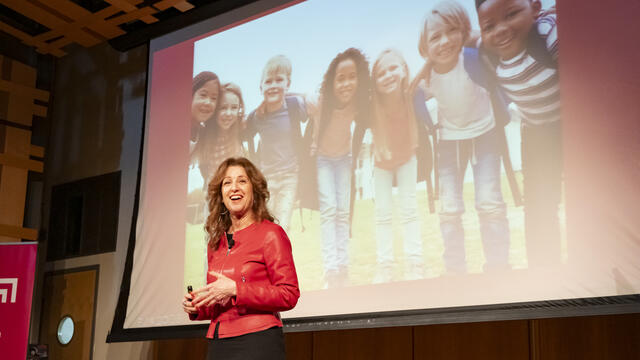
Professor of instruction and leading children’s media expert Sherri Hope Culver discusses the popularity and success of the Disney Channel Original Movie.

Sherri Hope Culver, a foremost expert on children’s media and professor of instruction at Klein, explains the popularity and impact of High School Musical.
Photo by Ryan S. Brandenberg
Twenty years ago, Troy Bolton and Gabriella Montez had the ultimate meet-cute when they sang karaoke at a holiday party while on vacation with their respective families. By chance, they ran into each other again at East High, where they auditioned for the school musical. The rest is history.
When High School Musical premiered in January 2006 on Disney Channel, audiences were introduced to Troy and Gabriella along with other East High Wildcats Sharpay and Ryan Evans, Chad Danforth, Taylor McKessie, and more.
The TV film quickly bopped to the top, becoming the highest-viewed premiere for a Disney Channel Original Movie ever with 7.7 million viewers until High School Musical 2 in 2007 shattered that record with 17.2 million viewers.
The success and popularity of the movie spawned an entire franchise, with High School Musical 3: Senior Year even hitting theaters in 2008.
High School Musical also launched the careers of its cast including Zac Efron, Vanessa Hudgens, Ashley Tisdale and others as well as paved the way for future Disney Channel franchises such as Camp Rock, Descendants and Zombies.
Temple Now spoke with Sherri Hope Culver, professor of instruction and director of the Center for Media and Information Literacy at Temple’s Klein College of Media and Communication and a leading academic expert on children’s media, about why High School Musical still strikes a chord today and how it has influenced other content for kids and adolescents.
Temple Now: What made High School Musical so popular?
Sherri Hope Culver: It ticks several boxes: It takes place at school, a relevant kid space, and focuses on the drama and comedy of high school life. It features good-looking people. The movie has songs created by individuals who understand how to make catchy pop music melodies and easy-to-memorize lyrics. At the time, it also capitalized on virality by creating a dance kids wanted to learn. And High School Musical has a positive message. Having the power of Disney behind it doesn’t hurt. Could even Disney have realized then the juggernaut the film would become?
Temple Now: What is the movie’s impact on children’s media?
Culver: High School Musical confirmed that it’s worth creating TV movies for kids because they can garner a huge audience and make money. Any time the media industry sees something successful that makes money, copycats emerge.
The movie also raised expectations for kids. It feeds into this feeling as an audience member that there should be movies made for me. High School Musical is based on a realistic (enough) story with authentic relationships and drama about academic life. Emotional moments in middle school and high school are impactful in a child’s life.
Temple Now: Why does High School Musical still resonate with audiences?
Culver: The parental influence can’t be overlooked. I watched it with my young daughter when it came out, and I probably wouldn’t have discovered it if I didn’t have a child. We had a great time watching it together and watching the sequels. High School Musical became part of my own media lexicon. You can mention Troy and Gabriella to me, and I know who you’re talking about.
Additionally, viewers in the older age range of that movie when it was released are now having kids of their own. A unique aspect of children’s media is you’re always going to have a new crop of kids watching. As children age and eventually have their own children, they want to share what they loved with their kids. There’s always that dual possibility in kids’ media that isn’t necessarily present with other media. This 20-year milestone gives Disney a chance to do retrospective looks at the movie too.
Temple Now: Disney Channel is known for its original movies. How did High School Musical grow or elevate the network?
Culver: Making an investment in producing a feature-length film isn’t something that most television networks are going to take on without some deep belief that it’s going to be successful. And that was especially true before streaming. That’s why so much content is based on intellectual property that already exists because companies know there’s an audience for it. Developing a TV movie like High School Musical means creating new characters, and there’s no guarantee that kids are going to connect with those characters. That’s a big financial risk. In this case, it paid off as High School Musical became a huge intellectual property for Disney, spawning two other movies, a TV show, a competition series and massive merchandise revenue.
When the trailer was first released, I remember watching the excitement from my daughter and her friends grow. Disney was sending kids into a frenzy of anticipation. It was unusual for a children’s network to create an original film with songs that turned into popular music. Kids already felt that Disney Channel was a special place just for them, and now there’s a movie that’s made for you. It felt special to children.