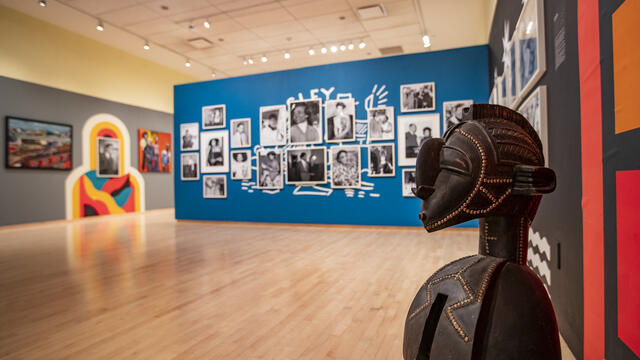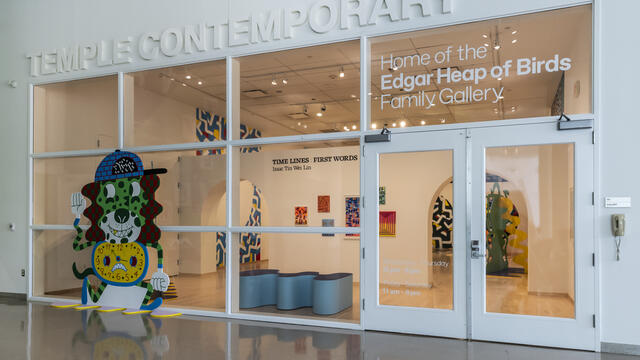
The Edgar Heap of Birds Family Artist Residency and Exhibition program at Tyler School of Art and Architecture highlights Native American artists.
Photo by Ryan S. Brandenberg
When renowned Cheyenne and Arapaho artist Edgar Heap of Birds, TYL ’79, made a gift to the Tyler School of Art and Architecture to create a new gallery and artist residency in his name, he had one objective: to create more awareness of Native American and Indigenous art and activism.
Now, with Navigating New Places: Norman Akers, the culminating exhibition of works created by the inaugural resident artist Norman Akers, on view and the recent announcement of the second resident, Anna Tsouhlarakis, the gallery is establishing itself as an integral part of Temple’s cultural tapestry.
“Norman’s presence in our studios created meaningful opportunities for students and faculty to learn directly from his perspective and the ideas that shape his work,” said Susan E. Cahan, dean of Tyler. “As the Edgar Heap of Birds Family Artist Residency enters its second year, we remain sincerely grateful to Edgar for establishing a program that gives so much to our community.”
As a dedicated 750-square-foot exhibition space inside Temple Contemporary on the first floor of Tyler School of Art and Architecture, the Edgar Heap of Birds Family Gallery features annual exhibitions of work by artists whose primary focus is the history and lived experiences of federally recognized tribal citizens in North America—their lives, struggles and triumphs. The residency provides studio space, access to facilities and equipment, a $1,500 budget for materials, a monthly $3,500 stipend, and a solo exhibition in the gallery.
For Heap of Birds, the presence of his own name speaks volumes. “When a gallery has a Native American name rather than an Anglo name, the presence of a Native family is remembered. I feel really good about the name being featured every day,” said Heap of Birds. “We need more presence of Indigenous populations in mainstream culture.”
A native of Oklahoma City, Heap of Birds taught at the University of Oklahoma for 30 years and is now a professor emeritus in the Native American Studies Department. His work has been featured in art institutions across the world, including Walker Art Center in Minneapolis, The Fabric Workshop and Museum in Philadelphia, the Whitney Museum of American Art, the Museum of Modern Art in New York City, and, most recently, the Palais de Tokyo in Paris, among many others. He has been the recipient of awards from the Andy Warhol Foundation for the Visual Arts, the National Endowment for the Arts and The Rockefeller Foundation.
Much of his work, such as “Surviving Active Shooter Custer” and “Reclaim,” uses language itself as medium and subject matter. “It's kind of a cliche, but I take the English language and turn it around and use it against the empire,” said Heap of Birds.
The gallery and residency are a way of creating opportunities for other artists to flourish in their work. “I wanted to make Tyler a more welcoming place where Native artists can belong,” said Heap of Birds.
Akers, an Oklahoma-based Osage painter and printmaker who teaches at the University of Kansas, describes the residency as a transformational moment in his career. “Painting requires presence. I have to be with the work every day. The residency afforded me the opportunity to be in the studio six days a week, eight to 10 hours a day,” said Akers. “I thoroughly embraced having time to live in that space and live with the work.”
The work on display in Navigating New Places: Norman Akers explores themes of colonialism and a struggle to reclaim cultural context. During the residency, Akers found inspiration in Philadelphia. “A lot of my work deals with the notion of borders, boundaries and colonialism. So, being in the birthplace of that whole myth of American colonialism, I was curious about how the environment would impact my work,” said Akers.
While painting in his studio at Tyler, he maintained an “open-door policy” that welcomed anyone from the community to come and chat.
“Being able to engage with the students made my time there even richer. The students got to see a whole body of work created during the time that I was there and I think that was important for them,” said Akers. “And of course I can carry that experience of being on the East Coast back with me to my home in Oklahoma and Kansas.”
Akers served on the selection committee for the next artist, Colorado-based Navajo sculptor and performance artist Anna Tsouhlarakis. Tsouhlarakis was chosen in part because of dedication to Native communities and her complexity as an artist, educator and parent. “She’s a mother and a community person, and she brings all those priorities into her work,” said Heap of Birds.
Alongside his vision of creating opportunities for Native artists, Heap of Birds hopes the gallery can be a model of generosity in the art world. “People expect artists who are well-known to be demanding or difficult. But you don’t have to be that way. You can be helpful.”