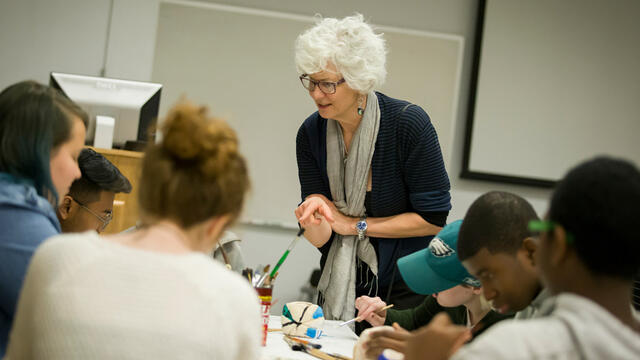
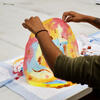
A student participates in a dye project as part of an Art Therapy class session.
Tyler School of Art and Architecture is launching a new graduate degree in art therapy. Beginning in fall 2026, the new Master of Arts program will complement Tyler’s existing undergraduate art therapy degree, charting a course for students interested in pursuing board certification as professional art therapists.
Given the success of Tyler’s undergraduate art therapy program since its establishment in 2017, creating a new graduate degree to meet student demand was a natural progression. “This new degree has been incubating since we started the bachelor's program,” said Lisa Kay, professor and chair of Art Education and Community Arts Practices. “We are thrilled to be implementing this new program at a time when interest in the field of art therapy has increased, and the need for mental health practitioners and credentialed art therapists is growing,” she explained.
A Legacy of Art as Healing at Tyler
Although the master’s program is new, art as a tool for healing is rooted in Tyler’s history. The school’s commitment to art as a stabilizing, restorative practice traces back to its founders—sculptor and philanthropist Stella Elkins Tyler and the school’s first dean, Boris Blai—who shaped the institution’s earliest vision nearly a century ago. Their collaboration was grounded in a shared belief that creative work could offer clarity and calm during moments of personal challenge, establishing a legacy of understanding the role art can play in supporting well-being.
“Tyler was founded on a profound belief in the power of art. The expansion of our art therapy program embodies that conviction and deepens our commitment to the vital role art plays in community life, personal transformation, and the greater good,” said Dean Susan E. Cahan.
“Tyler was founded on a profound belief in the power of art. The expansion of our art therapy program embodies that conviction and deepens our commitment to the vital role art plays in community life, personal transformation, and the greater good.”

Susan E. Cahan
Dean of Tyler School of Art and Architecture
Building on Strong Community Partnerships
According to Michaela Herr Hlubik, undergraduate art therapy program head at Tyler, one of the department’s greatest strengths is its longstanding network of community partnerships. “These partnerships will give the master’s program a unique foundation for rich clinical experience and professional connection within Philadelphia and beyond,” said Herr Hlubik, who currently coordinates fieldwork placements.
In addition to extensive fieldwork, students will engage deeply with the theoretical foundations of art therapy, studying frameworks that connect creative practice to psychological, social, and cultural contexts. They will also have opportunities for interdisciplinary research across Tyler and Temple to broaden their perspectives and strengthen the impact of their work.
“I feel excited to be part of an R1 research institution with a medical school and robust psychology and education programs. Our graduate art therapy students will engage in collaborative, connected research that allows them to see themselves as practitioners and scholars working at these intersections, learning to ground arts-based therapy within a clinical model,” said Kathryn Snyder, assistant professor of Art Therapy.
A Collaborative, Cross-Disciplinary Learning Environment
Interdisciplinary learning is central to the student experience at Tyler, creating an environment where students expand their perspectives through shared inquiry and hands-on collaboration. As the art therapy program grows, students will work alongside peers in art education and across Tyler’s studio and design programs, gaining insight into diverse creative practices and pedagogies.
“One of our synergies is the way faculty and the programs inform and inspire one another,” said Kay. “Our students will benefit from a dynamic, open exchange that deepens their practice and prepares them to engage others therapeutically with insight, creativity and compassion.”
MA in Art Therapy
Read about the new Master of Arts in Art Therapy program at Tyler School of Art and Architecture.