
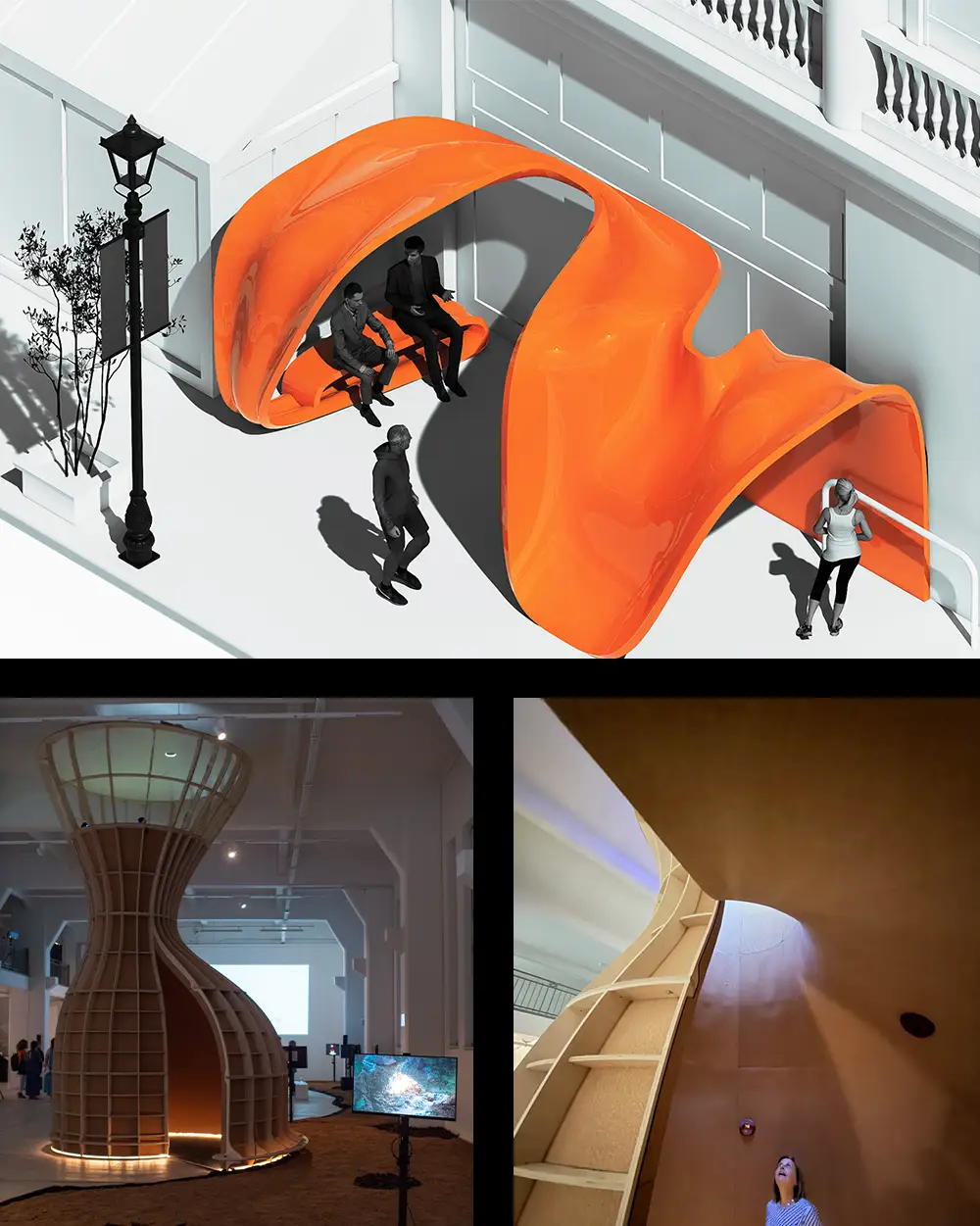
Embodied Environments features exciting new work from the Synesthetic Research and Design Lab at Thomas Jefferson University and from Architecture students at the Tyler School of Art and Architecture, which examines how people sense, perceive, and inhabit space. Through a brief research presentation, a short film, and a panel discussion, this program explores how responsive built environments can support co-regulation for and with neurodivergent individuals in urban space typologies. This event is accompanied by a research table and poster presentation that participants are invited to explore before and after the event.
Image:
Top: Broad Street Intervention: Curvilinear threshold proposal for the Broad Street entrance of Terra Hall. Tyler student work by Emma Lattin, Hayden Chen, Hody Ngan, and Henry Prunty. Instructor: Na Wei.
Bottom Left and Right: Interior and exterior views of the installation Echoes, exhibited in Kapnergostasio Museum of the Hellenic Parliament by Severino Alfonso and Loukia Tsafoulia, Synesthetic Research and Design Lab.
Accessibility
This event is wheelchair accessible. ASL interpreters and live captions will be available. Please contact Maggie Dunkle (maggie.dunkle@temple.edu) for any accommodation requests or accessibility questions.
Know Before You Go Guide (PDF)
This event will be simulcast on Zoom at this link:
https://temple.zoom.us/j/95422216094
Panelists
Severino Alfonso (he/him) and Loukia Tsafoulia (she/her) are faculty at Thomas Jefferson University’s College of Architecture, Design and Engineering, where they have founded and co‑direct the Synesthetic Research and Design Lab (SR&DL) —an interdisciplinary research and design laboratory that integrates architecture and neuroarts, with cognitive sciences, and Human Computer Interaction to explore the sensory, spatial, and cultural dimensions of human experience and perception. Through sensory multi-modal sculptural works and immersive installations, they draw associations between the symbolic world of objects and spaces and notions of embodiment, corporeality, and acceptance of perceptual differences.
synestheticdesignlab.com
nae vallejo (they/he) is a Black, Caddo, Mexican, queer, trans, disabled, AuDHD access designer and experiential archivist based in Germantown, Philadelphia. Their work moves through memory, rememory, and care, exploring how survivors leave trace across body, land, and story. As the founding steward of naeborhood projects, nae creates art and experiences that weave disability justice, sensory attunement, and community connection into everyday practices of survival and tenderness.
Henry Prunty (he/him) is a third-year undergraduate student at Tyler School of Art and Architecture. He is enrolled in the Bachelor of Architecture program as well as the 4+1 City and Regional Planning program. His work at Tyler has included research exploring how architectural intervention can directly influence emotional responses.
Moderator
Na Wei (she/her) is an architect, educator, and researcher whose career bridges design practice, pedagogy, and interdisciplinary scholarship. With nearly two decades of professional practice and teaching across leading institutions in the United States and China, she has developed original methodologies including Emotive Design and Acupuncture Architecture. Her monograph Suffused Space consolidated this practice-based framework. Her recent work extends this trajectory through Empirical Research–Integrated Design (ERID).