
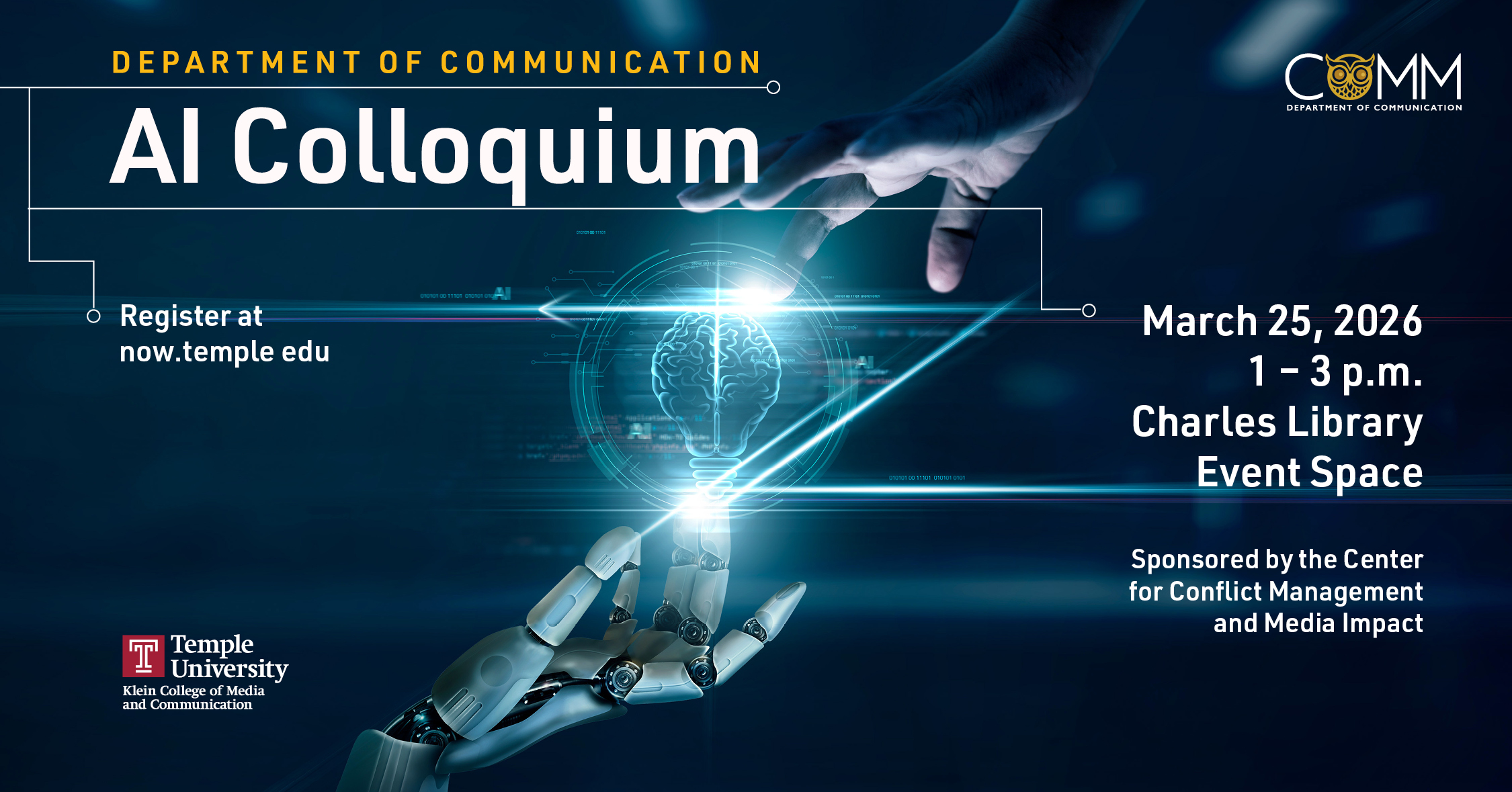
How will AI impact the human experience in fields like activism, conflict management, digital literacy, and health?
Hosted by Klein College’s Department of Communication and sponsored by the Center for Conflict Management and Media Impact, explore the intersection of AI and communication at this unique colloquium covering the latest from deepfakes to democracy.
Lunch will be provided.
Meet the Speakers
Metacognitive AI Literacy: Thinking about Thinking with Artificial Intelligence
In response to recent breakthroughs and the rapid adoption of generative artificial intelligence, AI literacy frameworks are being developed to help individuals understand and navigate the challenges and opportunities of AI technologies.
Building on traditional frameworks of science literacy, this presentation advances metacognitive AI literacy, defined as the capacity to reflect on how interactions with AI systems shape thought processes, belief formation, knowledge production, reasoning and interpersonal communication.
Findings from a multi-method research program conducted during Temple University’s 2025 Interactive AI Fair, together with data from a national survey of more than 1,000 U.S. adults, demonstrate that fostering metacognitive awareness is critical for the development of comprehensive AI literacy initiatives.
Tricia Jones - virtual
Artificial Intelligence and Access to Justice — Challenges and Opportunities for Dispute Resolution Systems
A basic tenet of the rule of law, a necessity for democratic societies, is access to justice — providing stable, legitimate justice systems with neutral and trustworthy decision-making processes that enable people to bring their disputes to court for resolution (Ahmad, 2025). Billions of people around the globe have increased access to justice through online dispute resolution (ODR) systems using dispute resolution processes including mediation, arbitration and judicial proceedings.
Today, ODR systems resolve cases by the millions in family, consumer and commercial, administrative, educational, and criminal disputes. ODR is increasingly dependent on Artificial Intelligence platforms to process those disputes. This presentation discusses the significant challenges and potential harms of AI/ODR as well as the potential necessity and advantages of AI's functionality in "justice impoverished" societies.
Me, My Self, Diabetes, and [A]I: Un/der Insured people using artificial intelligence for health treatment advice
According to latest census data, the number of individuals with no insurance or insurance that inadequately covers the cost of medical treatment for diabetes increased nationwide between 2023 and 2024. In addition, fears concerning immigration status have kept some patients out of health centers and doctors’ offices for fear of deportation.
This talk explores the possibilities and pitfalls of using AI for diabetes information and treatment based on digital divides and digital literacies.
Jennifer Woolley Barone and Tom Wright
AI and Activism: Deepfakes, Slop, and the Downsides of the Divide
In our contemporary digital landscape, Artificial Intelligence (AI) and digital activism are ubiquitous online phenomena. This session will examine the role and risks that AI poses to digital activism in our current political environment, with a focus on deepfakes, content sloppification and memetic propaganda. Although digital platforms amplify underrepresented voices, they also enable their appropriation.
Focusing on strategies of ventriloquism, sound bites, and metonymic visual appeals, this session examines how AI tools perpetuate the political divide in an online environment geared toward luring short-form content.
User Trust in AI-Based Therapy: Comparing Perceptions of Comfort, Empathy, and Privacy Between Human and Machine Counselors
As artificial intelligence tools become increasingly integrated into mental health and wellness communication, questions remain about how users interpret emotional support delivered by AI systems. This presentation looks at how perceptions of trust, empathy, comfort, and privacy differ when counseling responses are presented as human-delivered versus AI-generated.
Drawing from communication research, the project considers how labeling and presentation influence users’ willingness to engage with AI-based counseling tools. This project examines audience perceptions and is intended to inform a future experimental study.
By comparing audience responses to human and AI counseling messages, the project highlights potential benefits and concerns related to AI-mediated emotional support.
The findings contribute to ongoing discussions about ethical AI use, emotional safety, and trust in digital communication environments, particularly within health, education, and support contexts.